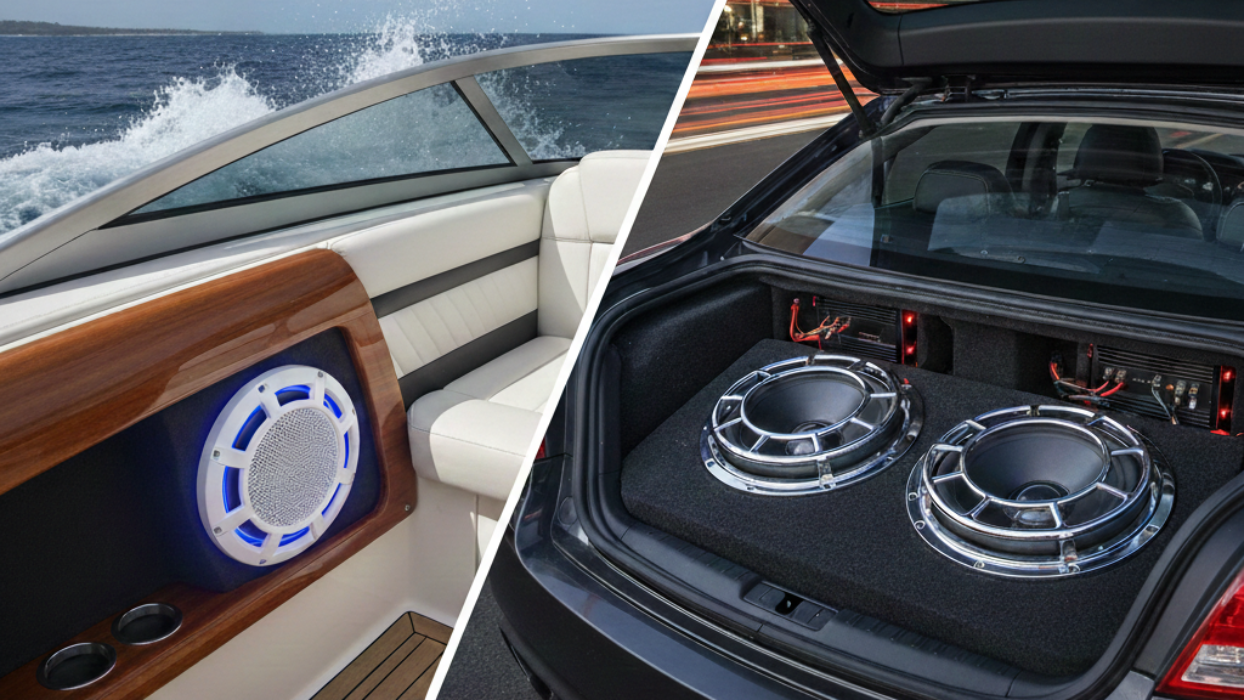
Marine subwoofers rarely produce the same deep-bass feel as car systems because boats don’t provide the enclosed cabin reinforcement that makes low frequencies build up. In most boats, bass energy dissipates into open air, front-and-rear wave cancellation is harder to prevent, and higher ambient noise pushes the system toward louder midbass instead of true sub-bass.
Why Deep Bass Is Easier in Cars Than on Boats
A car cabin is a small, mostly enclosed space. Below a certain frequency, the cabin tends to reinforce bass, often called cabin gain or the vehicle transfer function, which can make low bass rise significantly compared to open air.
A boat’s listening space is usually the opposite. It’s open, leaky, and irregular, so the same subwoofer and power level won’t get the same low-frequency reinforcement.
The Physics Problem Most Marine Systems Can’t Escape
Deep bass needs air control. Low frequencies have long wavelengths, so the system needs boundaries and pressure buildup to feel “deep” at the listening position. When the environment is open, that energy disperses instead of building, and you’re left needing more cone area, more power, and better placement to get the same perceived result.
Enclosure and Mounting Limit How Low You Can Realistically Go
Marine installs often use one of two approaches:
- Sealed enclosures: The sub sits in a true enclosure that controls cone motion and keeps response more predictable.
- Infinite baffle (free-air) mounting: The sub mounts to a rigid surface that separates front and rear sound waves, using a large cavity behind it instead of a sealed box.
Both can work, but the open environment means neither behaves like a car trunk or cabin unless the mounting is rigid and the rear wave is well isolated.
Cancellation Is the Silent Bass Killer on Boats
If the rear wave from the sub mixes with the front wave, bass cancels. That’s especially common with free-air installs that aren’t sealed well around the baffle, or with seat bases and compartments that leak into adjacent spaces. KICKER’s infinite baffle guidance stresses sealing the baffle area specifically to prevent front-to-rear wave cancellation.
Noise Floor Pushes Systems Toward Upper Bass
At speed, wind and engine noise rise. That noise masks the lower frequencies that you’d normally call deep bass, so many boat systems end up tuned to emphasize upper bass and midbass presence because it stays audible outdoors. That’s one reason marine systems can sound strong and punchy without feeling “low” in the way a sealed car cabin can.
Overview: Car vs Boat Bass
| Factor | Cars | Boats | What It Means for Bass |
|---|---|---|---|
| Cabin reinforcement | Often strong at low frequencies | Minimal in open air | Deep bass is easier in cars |
| Rear-wave isolation | Easier with trunk/cabin structure | Harder with leaky cavities | Cancellation risk rises |
| Ambient Noise | Lower and more consistent | Higher and variable | Low bass gets masked sooner |
How to Get Deeper Bass on a Boat Without Chasing Myths
If your goal is deeper bass presence, the path is usually more about system design than about finding a magical subwoofer.
Prioritize a Real Enclosure When You Can
A sealed enclosure gives you the most predictable control over cone motion and low-frequency behavior, which matters when the environment isn’t helping you.
Treat Free-Air Mounting Like a Construction Project
Infinite baffle installs can work well, but only when the mounting surface is rigid and sealed so the rear wave can’t wrap around and cancel the front wave.
Use Filtering to Protect the Sub and Keep Output Cleaner
Ported alignments and some free-air installs can unload below certain frequencies. Proper high-pass filtering on the sub channel (often called a subsonic filter) reduces wasteful excursion and helps the system stay cleaner at higher volume.
Add Cone Area Before You Add Aggressive Boost
In open air, forcing deep bass with EQ can turn into heat and distortion quickly. If you need more authority, additional cone area and adequate amplifier headroom usually scale more predictably than heavy low-frequency boost.
Marine Subwoofers That Fit Common Upgrade Paths
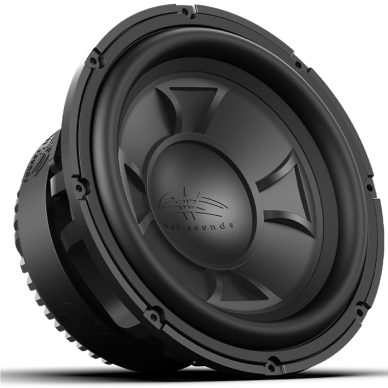
- Wet Sounds REVO 12 XXX V4-B – A high-output 12-inch option that makes sense when your system goal is strong bass presence in an open environment.
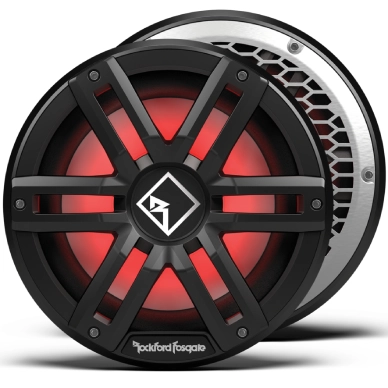
- Rockford Fosgate M2D2-10SB-G2 – A sealed-marine model that fits builds where you can dedicate enclosure volume and want predictable control.
- JL Audio M6-10IB-L-GwSw-4 – An infinite-baffle-capable design for installs where you can’t run a traditional sealed box but can build a proper baffle.

The Practical Takeaway
Marine subwoofers can sound excellent, but boats don’t naturally support deep bass the way cars do. Without cabin gain and strong boundary reinforcement, you’re relying on enclosure control, baffle sealing, placement, and enough cone area to create the low-frequency experience you’re expecting.
About The Authors

Benjie B.
Benjie has been writing automotive content for six years, and he loves the idea of democratizing knowledge through well-written and easy-to-understand content. He particularly enjoys the learning process behind writing and he’s fascinated by how vehicles and how the systems behind them work. Now, his work at Sonic Electronix has exposed him to the rabbit hole that is car audio systems, and he now wants to upgrade his family’s 20-year-old Toyota Yaris with a high-fidelity system someday. He enjoys watching content creators on YouTube, and he’s currently an avid cyclist, training so that his friends don’t leave him behind on group rides.

Dustin H.
Dustin is passionate about delivering honest car audio advice that serves both first-time buyers and seasoned car audio enthusiasts. A veteran of the car audio industry, he continues to learn about car audio space while building some systems of his own. Outside of his work in car audio, he’s active in his local church and enjoys spending time with family.