Selecting the right digital signal processor (DSP) can be the single most impactful upgrade for your car audio system.
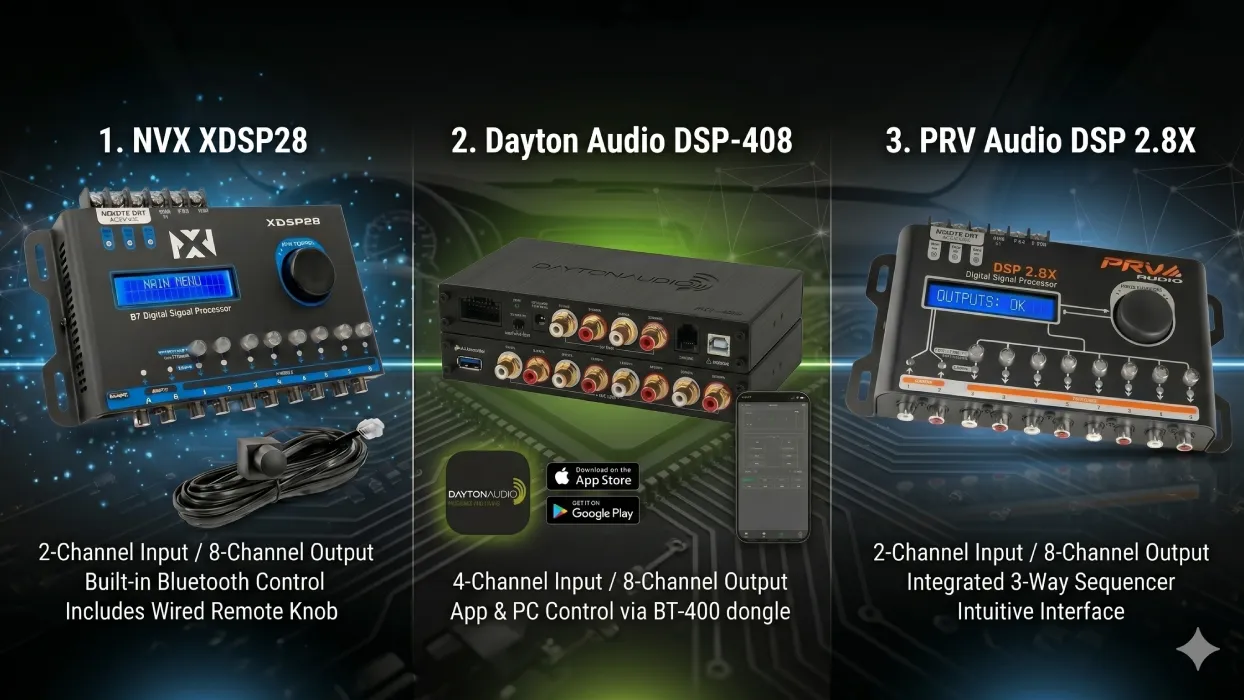
For those starting their journey, the NVX XDSP28, Dayton Audio DSP-408, and PRV Audio DSP 2.8X represent the best value in the category today.
These units provide the essential tools needed to transform a muddy factory soundstage into a crisp, balanced listening experience.
While each offers unique strengths in connectivity and control, they all share a common goal of making professional-level tuning accessible to hobbyists on a budget.
Key Insights
- Digital Signal Processors are the most effective way to improve sound quality by allowing for precise control over equalization, time alignment, and crossovers.
- The NVX XDSP28 is the top recommendation for most users because it combines deep tuning features with a convenient Bluetooth and onboard interface.
- While the Dayton Audio DSP-408 excels at factory integration and the PRV Audio DSP 2.8X offers high-value basics, all three units provide 8-channel output for maximum system flexibility.
Why a DSP Is the Best Upgrade Per Dollar
A digital signal processor lets you tune your system the way a professional installer would.
You can correct frequency response with an equalizer, align speakers with time delay, and set proper crossovers so each speaker plays only the frequencies it was designed to handle.
Even with modest speakers and amplifiers, a DSP often delivers the largest audible jump in clarity, staging, and bass control.
It essentially acts as the brain of your audio system, ensuring every component works in perfect harmony with the unique acoustics of your vehicle.
What to Look for in a DSP Under $250
When you’re a first-time buyer, it’s easy to get overwhelmed by technical jargon. Focus on these five factors to ensure you get the most out of your investment:
1. Input Compatibility: If you have an aftermarket head unit with RCA outputs, a standard RCA-input DSP is easy to install.
But if you’re keeping your factory stereo, look for a unit with speaker-level (high-level) inputs or plan to use a separate line output converter.
2. Output Count: eight outputs are the ideal sweet spot for budget builds. This supports a front active setup (separate channels for tweeters and woofers), rear speakers, and a subwoofer while leaving room for future growth.
3. EQ and Crossovers: Look for a multi-band equalizer and crossovers with common filter types like Linkwitz-Riley or Butterworth. This allows you to blend your speakers seamlessly.
4. Time Alignment: You need enough delay range to compensate for the different distances between your ears and each speaker. This “centers” the soundstage on the dashboard.
5. Control Method: A DSP is only useful if you can actually navigate the software. Whether it uses a PC, a smartphone app, or an onboard interface, make sure the workflow makes sense to you.
Top 3 Budget DSPs for First-Time Tuners
1. NVX XDSP28 (Best Overall Value and Ease of Use)
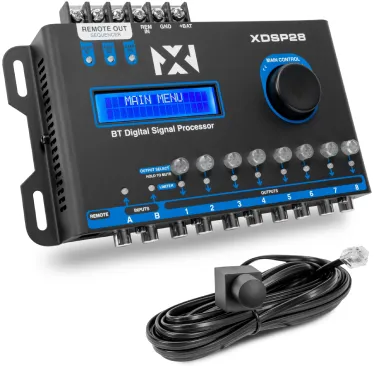
The NVX XDSP28 is the standout choice for those who want a modern, feature-rich experience without the high price tag.
It balances sophisticated tuning capabilities with an incredibly user-friendly interface. Unlike many competitors that require a laptop for every minor adjustment, the XDSP28 features built-in Bluetooth and an onboard LCD screen with a control knob.
This makes it the most practical “daily driver” DSP in this price range, as it allows for quick tweaks and preset switching directly from the driver’s seat.
Key Specs
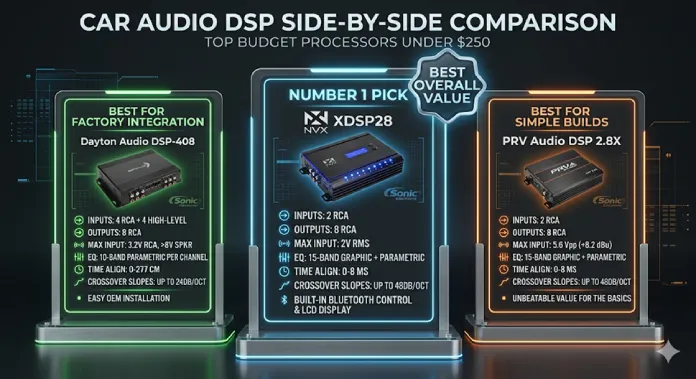
- Crossover Types and Slopes: Butterworth and Linkwitz-Riley; 12, 18, 24, 36, and 48 dB per octave
- Inputs and Outputs: 2 input channels plus Bluetooth input; 8 RCA outputs
- Max Input Level: 2V RMS maximum input voltage
- Equalization (EQ): 15-band graphic EQ and parametric EQ options
- Time Alignment Range: 0 to 8 ms (approximately 275 cm)
Why it’s a good buy
The NVX XDSP28 offers a ridiculous price-to-feature ratio. For a very modest investment, you get an 8-output processor with steep crossover slopes and precise time alignment.
The combination of an onboard interface and Bluetooth connectivity is a game-changer for beginners who want to see their adjustments in real time without fumbling with cables. It’s a perfect match for systems running aftermarket head units.
2. Dayton Audio DSP-408 (Best for Factory Integration)
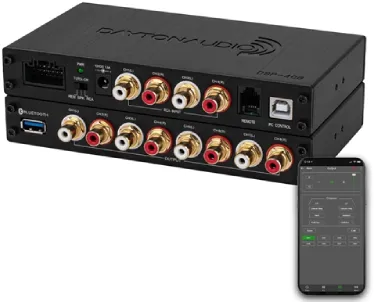
The Dayton Audio DSP-408 is a proven entry-level unit that’s exceptionally flexible for the money. Its primary strength lies in its ability to accept both RCA and speaker-level inputs right out of the box.
This makes it a strong contender for those who want to keep their factory radio but still want high-end tuning tools.
Key Specs
- Crossover Types and Slopes: Linkwitz-Riley, Butterworth, and Bessel; 6 to 24 dB per octave
- Inputs and Outputs: 4 RCA inputs and 4 high-level inputs; 8 RCA outputs
- Max Input Level: 3.2V (RCA) and ≥8V (Speaker Level)
- Equalization (EQ): 10-band parametric EQ per channel
- Time Alignment Range: 0 to 277 cm (approximately 8.14 ms)
Why it’s a good buy:
This is the best “OEM-to-aftermarket” bridge in this price range. Because it includes high-level inputs, you can often skip the need for extra converters.
It provides all the core tools, such as parametric EQ and time alignment, that you will continue to use even as your system grows more complex.
3. PRV Audio DSP 2.8X (Best Budget Performance)
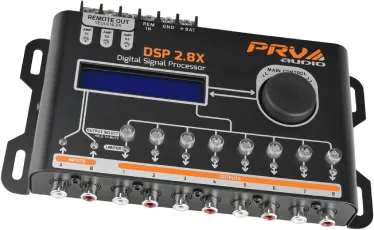
The PRV Audio DSP 2.8X is a no-nonsense processor designed for maximum functionality per dollar. It’s a favorite in the “Pro Audio” car scene because it’s reliable and provides essential processing power for a very low entry cost.
Key Specs
- Crossover Types and Slopes: Butterworth and Linkwitz-Riley; 12, 18, 24, 36, and 48 dB per octave
- Inputs and Outputs: 2 input channels; 8 RCA outputs
- Max Input Level: 5.6 Vpp (+8.2 dBu)
- Equalization (EQ): 15-band graphic EQ plus parametric options
- Time Alignment Range: 0 to 8 ms (approximately 275 cm)
Why it’s a good buy:
If you’re looking for the absolute lowest entry point into the world of digital signal processing, the PRV is hard to beat.
It provides the fundamental tools needed to learn how crossovers and time alignment affect your sound.
Its eight-output architecture ensures that even if you start with a simple setup, you won’t be limited when you decide to add more amplifiers or speakers later.
About The Authors

Christine F.
Christine is a dedicated content writer with over five years of experience covering a variety of automotive and car audio topics, transforming technical knowledge into compelling and easy-to-understand content. She’s passionate about writing articles that educate, empower, and inspire drivers and audio enthusiasts everywhere. In her free time, she enjoys playing tennis and going on walks with her dog.

John Haynes
John is an industry veteran, with 35+ years in the mobile electronics industry. Starting as a floor salesperson for Al & Ed's Autosound, he became a top-seller using sales techniques acquired in prior industries. He successfully managed locations, and was the first "non-technician" to be MECP and MECP 1st Class certified. His stores were one of the few in the chain that did truly high-end systems. He left A&E to manage the SoCal territory for Clifford Electronics, then returned to Al & Ed's as the buyer. He quickly became the General Manager for the company, and served in that position for almost 20 years. He tried to retire during COVID, got bored and became the US Sales Manager for an aftermarket auto accessory company until his retirement in 2025.
John enjoys spending time with his wife, two children and three grandchildren and his dog, Kenny. He enjoys playing guitar and banjo, woodworking, photography and volunteers in his local hospital as well as the local baseball/softball complex. Of course, he stays involved in 12-Volt, as it's something that never leaves you once it's in the blood.
"I'm pleased to be working with the Sonic Electronix marketing team," says John. "Sonic is a premier e-tailer, and I'm happy to be involved with them."