Sealed marine subwoofers and free-air marine subwoofers are designed for fundamentally different operating conditions. Choosing the wrong type often results in weak bass, distortion, or premature subwoofer failure, especially in open-water environments.
The correct choice depends on where the subwoofer will be mounted, whether a proper enclosure is possible, and how much control you want over low-frequency output at speed.
What Actually Determines Marine Subwoofer Performance
Marine subwoofers face two challenges at the same time. They must survive harsh outdoor conditions, and they must produce usable bass in environments that are often open and acoustically unpredictable.
Because low-frequency energy dissipates quickly outdoors, enclosure behavior matters more in marine systems than it does in most car audio systems. Sealed and free-air marine subwoofers solve this problem in completely different ways, and they are not interchangeable even when size and power ratings look similar.
How a Sealed Marine Subwoofer Controls Bass
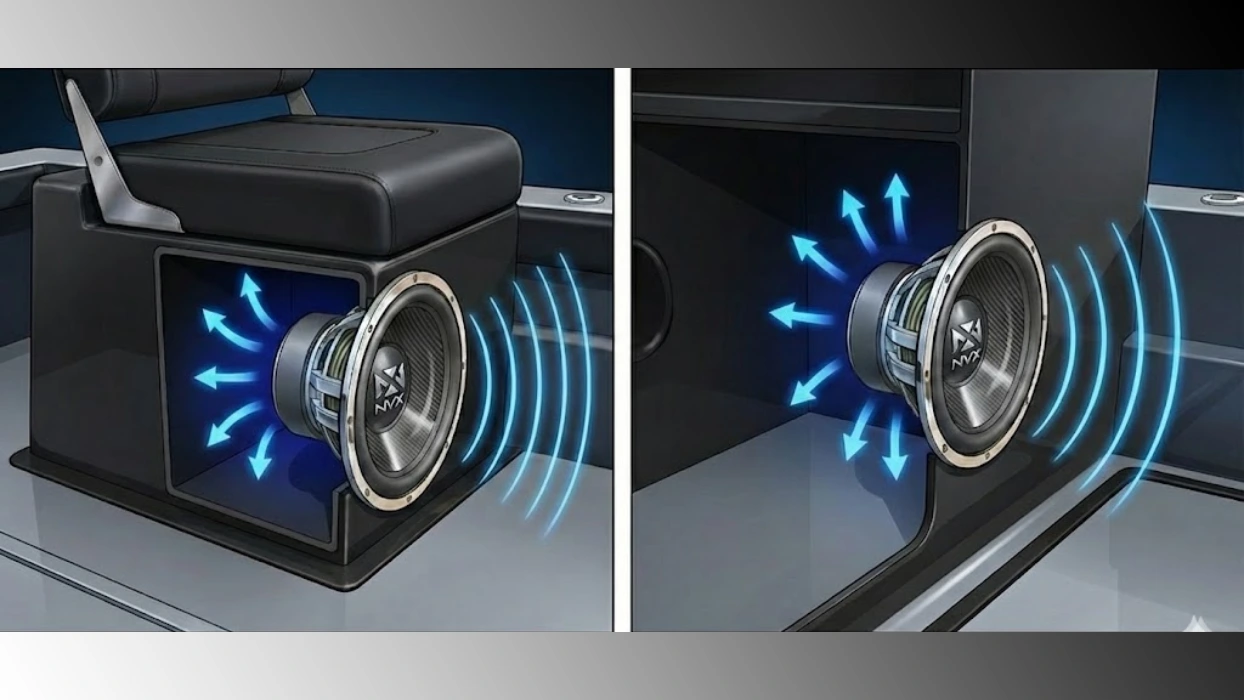
A sealed marine subwoofer is designed to operate inside an airtight enclosure. The air trapped inside the enclosure acts as a mechanical spring that limits cone movement and stabilizes the subwoofer.
As the cone moves inward, the air compresses and resists motion. As it moves outward, the air expands and pulls the cone back. This air resistance is part of the subwoofer’s design and directly shapes how it behaves at low frequencies.
In marine applications, sealed subwoofers are commonly installed in:
- Dedicated fiberglass or composite enclosures
- Fully sealed under-seat storage compartments
- Custom pods integrated into consoles or seating structures
Because the enclosure controls cone movement, sealed marine subwoofers deliver consistent bass regardless of how open the surrounding environment is.
Why Sealed Marine Subwoofers Sound More Controlled
Sealed enclosures limit excursion at very low frequencies. That reduction in cone travel lowers distortion and mechanical stress, especially when the subwoofer is driven hard.
This matters on boats because wind, engine noise, and wave noise mask bass output. Without enclosure control, a subwoofer may try to move farther than it should to compensate, which increases distortion and heat.
A sealed marine subwoofer trades some maximum output for predictability. Bass notes start and stop more cleanly, blend more easily with cockpit or tower speakers, and remain usable at higher speeds. Sound preference is subjective, but sealed designs are objectively easier to control and tune.
How Free-Air Marine Subwoofers Work
Free-air marine subwoofers, also called infinite baffle subwoofers, are designed to operate without a sealed enclosure behind them.
Instead of using trapped air for control, they rely on the mounting surface to separate the front and rear sound waves. As long as the rear wave cannot mix with the front wave, the subwoofer can produce bass without a box.
On boats, free-air subwoofers are typically mounted in:
- Bulkheads
- Console walls
- Seat bases that open into large cavities
- Partitions between compartments
The space behind the subwoofer does not need to be airtight. It simply needs to be large enough that rear-wave pressure does not interfere with cone movement.
Why Free-Air Marine Subwoofers Are Built Differently
Because there is no enclosure to limit cone motion, free-air marine subwoofers are engineered with stiffer suspensions and reduced excursion capability.
The spider and surround provide most of the mechanical control. As a result, power handling is usually lower than a comparable sealed subwoofer, and the margin for error is smaller.
Free-air subs are designed for situations where building a sealed enclosure is impractical or impossible. They prioritize installation flexibility over maximum output or deep bass extension.
Output and Bass Character Differences on the Water
The most noticeable difference between sealed and free-air marine subwoofers is how the bass feels in real use.
Sealed marine subwoofers produce tighter, more defined bass. Output remains more consistent across different listening levels, and low-end impact holds up better as boat speed and noise increase.
Free-air marine subwoofers produce broader, less controlled bass. Output is often strongest in the upper bass range rather than deep sub-bass. This can work well for casual listening but often sounds thin when wind and engine noise increase.
In open-air environments, sealed subwoofers usually maintain usable low-frequency impact longer than free-air designs.
Reliability and Long-Term Stress Considerations
From a durability standpoint, sealed marine subwoofers often experience less mechanical stress over time.
The enclosure limits cone travel and reduces the likelihood of bottoming out during high-volume use. Heat buildup is more predictable, and the subwoofer operates within a narrower mechanical range.
Free-air subwoofers rely entirely on suspension stiffness for control. In rough water or high-output situations, this can lead to greater mechanical fatigue if the system is not tuned carefully.
This does not mean free-air subwoofers are unreliable. It means they are more sensitive to installation quality and amplifier tuning. Proper high-pass filtering is especially important to prevent excessive low-frequency excursion.
Choosing the Right Marine Subwoofer Design
A sealed marine subwoofer is usually the better choice if:
- You want stronger, deeper bass
- You can install a proper sealed enclosure
- You listen at higher volumes or higher speeds
- You want more predictable tuning and control
A free-air marine subwoofer makes sense if:
- Space does not allow a sealed enclosure
- You are mounting in a bulkhead or console wall
- You want simpler installation with minimal fabrication
- Moderate bass presence is sufficient
Final Perspective
Neither sealed nor free-air marine subwoofers are universally better. Each design solves a different problem.
Sealed subwoofers prioritize control, consistency, and long-term stability. Free-air subwoofers prioritize installation flexibility and convenience. The system that performs better is the one that matches your mounting location, space constraints, and expectations for low-frequency output.
About The Authors

Benjie B.
Benjie has been writing automotive content for six years, and he loves the idea of democratizing knowledge through well-written and easy-to-understand content. He particularly enjoys the learning process behind writing and he’s fascinated by how vehicles and how the systems behind them work. Now, his work at Sonic Electronix has exposed him to the rabbit hole that is car audio systems, and he now wants to upgrade his family’s 20-year-old Toyota Yaris with a high-fidelity system someday. He enjoys watching content creators on YouTube, and he’s currently an avid cyclist, training so that his friends don’t leave him behind on group rides.

Dustin H.
Dustin is passionate about delivering honest car audio advice that serves both first-time buyers and seasoned car audio enthusiasts. A veteran of the car audio industry, he continues to learn about car audio space while building some systems of his own. Outside of his work in car audio, he’s active in his local church and enjoys spending time with family.