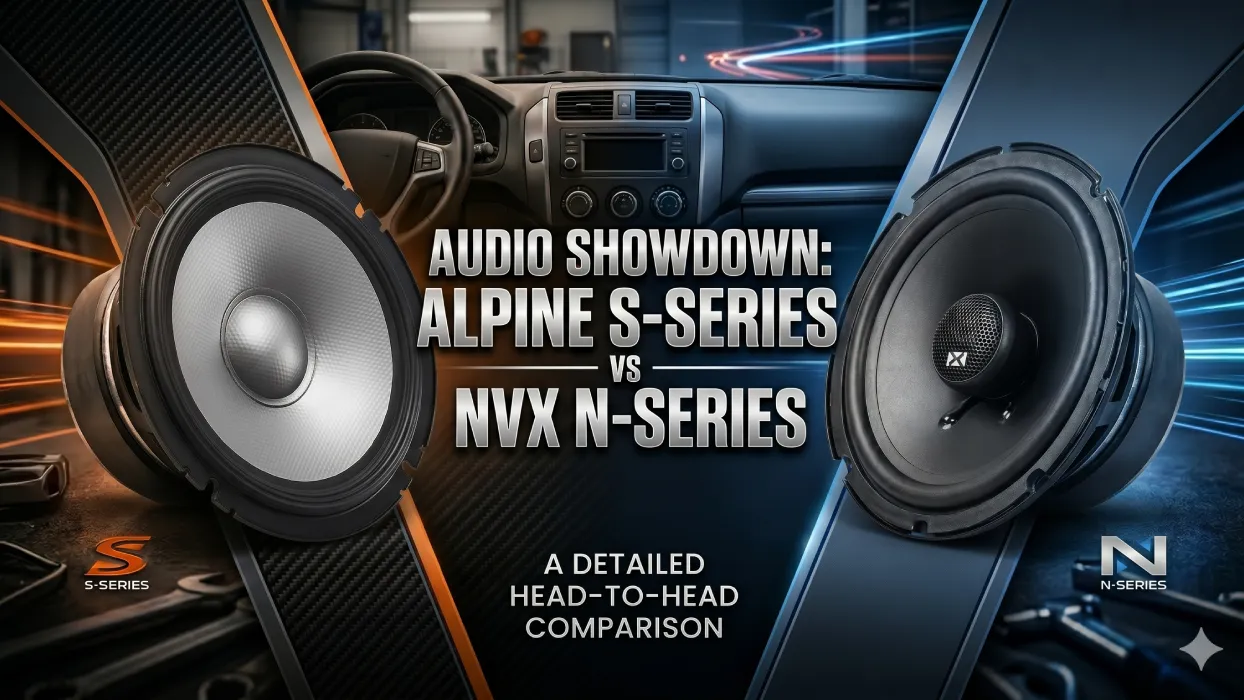
Which Is Better, Alpine S-Series or NVX N-Series?
For most older cars and daily drivers, NVX N-Series is usually the safer pick when you’re staying on factory radio power or you want the best value-per-dollar upgrade path.
Alpine S-Series is a strong choice when you want a polished, mainstream tuning approach and you care about the S-Series feature set like Hi-Res certification and factory-friendly component packaging.
The right call depends less on brand and more on power available, cabin noise, and whether you’re running coaxials or a real front-stage component set.
Fast Choice Guide for Real Builds
Best pick on factory head unit power
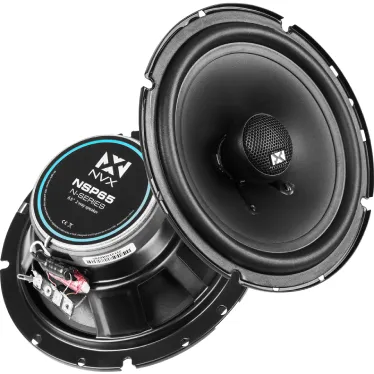
NVX N-Series coaxials (NSP65), because slightly higher rated continuous power (RMS) and sensitivity make them easier to live with when power is limited.
Best Front Stage Path on a 4-Channel Amp
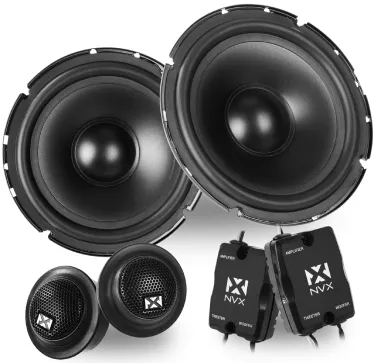
NVX N-Series components (NSP65KIT), because the component set is rated for more continuous power per side than Alpine’s comparable S-Series set, which helps when you’re aiming at 75–100W RMS per channel.
Best Mainstream Component Option
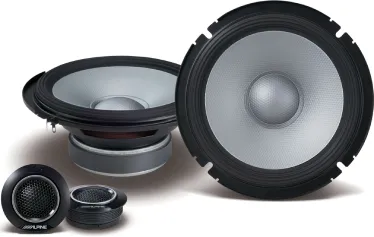
Alpine S-Series components (S2-S65C), especially if you want the included in-line crossovers and the S-Series approach to tweeter mounting and fitment.
The Honest Trade-Offs
Where NVX N-Series Tends to Win
- You’re optimizing for value and want specs that align well with common small-amp builds.
- You want a soft-dome treble approach and you’d rather put saved budget into basic door treatment and proper mounting.
- You like the idea of CEA-2031 compliance, as this ensures the product’s specifications are accurate and reliable.
Where Alpine S-Series Tends to Win
- You want a mainstream, widely supported line with clear model progression and fitment familiarity.
- You want an S-Series component set with the in-line crossover approach called out in the kit listing.
- You care about Hi-Res certification being part of the design and marketing intent.
Comparing The Alpine S-Series and NVX N-Series Speakers
1) Intended Role in the System
Start by choosing the role:
- Coaxials are best when you want a simple replacement in factory locations. The tweeter is built into the speaker, so staging control is limited.
- Components are best when you want a real front stage. The woofer and tweeter are separate, so you can mount the tweeter higher and improve imaging. Alpine’s S2-S65C is a component set, and NVX’s NSP65KIT is the N-Series component set.
If your goal is better sound with minimal labor, coaxials are usually the correct comparison. If your goal is better staging and clearer vocals, compare the component sets.
2) RMS Power vs the Power You Actually Have
RMS power is the continuous power rating. What matters is how that compares to your real source:
- Factory head units often deliver limited clean power, so chasing high RMS ratings doesn’t automatically help.
- If you’re adding a 4-channel amp, higher RMS handling can give you more clean headroom if you set gains correctly.
Representative examples in these two lines show NVX listing 90W RMS per coaxial for the NSP65, while Alpine lists 80W RMS per coaxial for the S2-S65.
On the component side, NVX lists 100W RMS per side for the NSP65KIT, while Alpine lists 80W RMS per side for the S2-S65C.
That doesn’t mean one will always play louder or cleaner. It means NVX’s published ratings align well with common small amp builds in the 75–100W range.
3) Sensitivity and Why It Matters on Factory Power
Sensitivity is how loud a speaker plays with a given amount of power. On factory power, a small sensitivity difference can matter.
- NVX NSP65 is listed at 89 dB sensitivity.
- Alpine S2-S65 is listed at 88 dB sensitivity.
- Both component sets are listed at 88 dB sensitivity.
These are close, so don’t expect a night-and-day loudness difference from sensitivity alone. The bigger takeaway is that both series are viable on factory power, but both also benefit clearly from real amplification if your goal is clean volume.
4) Driver Materials and What They Suggest About Voicing
This is where people over-focus, so it’s worth keeping grounded.
- NVX N-Series models here use polypropylene cones and silk dome tweeters.
- Alpine S-Series models here use a polypropylene, glass fiber, and mica cone blend and cloth dome tweeters, plus Hi-Res certification noted on the product listing.
Both silk and cloth are soft dome materials, which typically helps treble stay listenable in reflective car cabins. What you’ll hear day to day is still heavily shaped by tweeter location, door reflections, and EQ.
5) Crossover Approach for Component Sets
A component set’s crossover behavior matters because it decides how safely and smoothly the tweeter is used.
Alpine’s S2-S65C listing calls out in-line crossovers included with the tweeter wiring.
NVX’s NSP65KIT is listed as a full component system, and NVX also notes CEA-2031 compliance for the kit on its product page, which can be useful if you care about more standardized speaker measurement practices.
If you’re building a front stage and you’re willing to mount tweeters properly, components usually age better as an upgrade than coaxials.
What This Means in a Real SUV or Older Car
If You’re Keeping the Factory Radio
Factory power usually rewards:
- reasonable sensitivity
- smooth treble behavior
- speakers that don’t demand high power to sound full
That’s why the NVX NSP65 coaxials often make sense as a value-first upgrade, and the specs support that use case.
Alpine’s S2-S65 also fits factory power well, especially if you want the S-Series feature and design approach in a conventional coaxial package.
If You’re Adding a Small 4-Channel Amp
Once you’re in the 50–100W RMS per channel range, the system tends to reward:
- control and midbass stability
- proper high-pass filtering (so the door speakers aren’t trying to play deep bass)
- component staging and tweeter placement
If you want the most straightforward “amp-friendly” paper match, NVX’s NSP65KIT rating aligns well with that power range.
If you want the Alpine ecosystem approach with a component set that’s designed to be installed cleanly in common factory locations, the S2-S65C is the direct S-Series comparison.
Bottom Line
If you want the safest budget upgrade on factory power, NVX N-Series coaxials are usually the cleaner value decision.
If you’re building a front stage and you’ll amplify, compare the component sets and choose based on your install plan: NVX N-Series components for amp-friendly headroom, or Alpine S-Series components for the S-Series approach to component packaging and fitment.
If you tell me your vehicle, whether you’re staying on factory radio power, and whether you’re doing coaxials or components up front, I can narrow this to the better match with a realistic power and install plan.
About The Authors

Benjie B.
Benjie has been writing automotive content for six years, and he loves the idea of democratizing knowledge through well-written and easy-to-understand content. He particularly enjoys the learning process behind writing and he’s fascinated by how vehicles and how the systems behind them work. Now, his work at Sonic Electronix has exposed him to the rabbit hole that is car audio systems, and he now wants to upgrade his family’s 20-year-old Toyota Yaris with a high-fidelity system someday. He enjoys watching content creators on YouTube, and he’s currently an avid cyclist, training so that his friends don’t leave him behind on group rides.
Norman R.
Norman is a Senior Tech Support and Test Bench Representative for Sonic Electronix, with over 25 years of experience in building car audio systems. He enjoys working with car audio and the opportunity to showcase various products to potential customers. He also finds joy in working with the R&D team, as he gets to see future products and the company’s growth. A hot-rodder and basshead through and through, Norman is extremely passionate about fast, loud, and low cars. In his spare time, he frequently attends car shows and builds big stereos and hot rods. He hopes to one day pass on his skills and knowledge to his son.