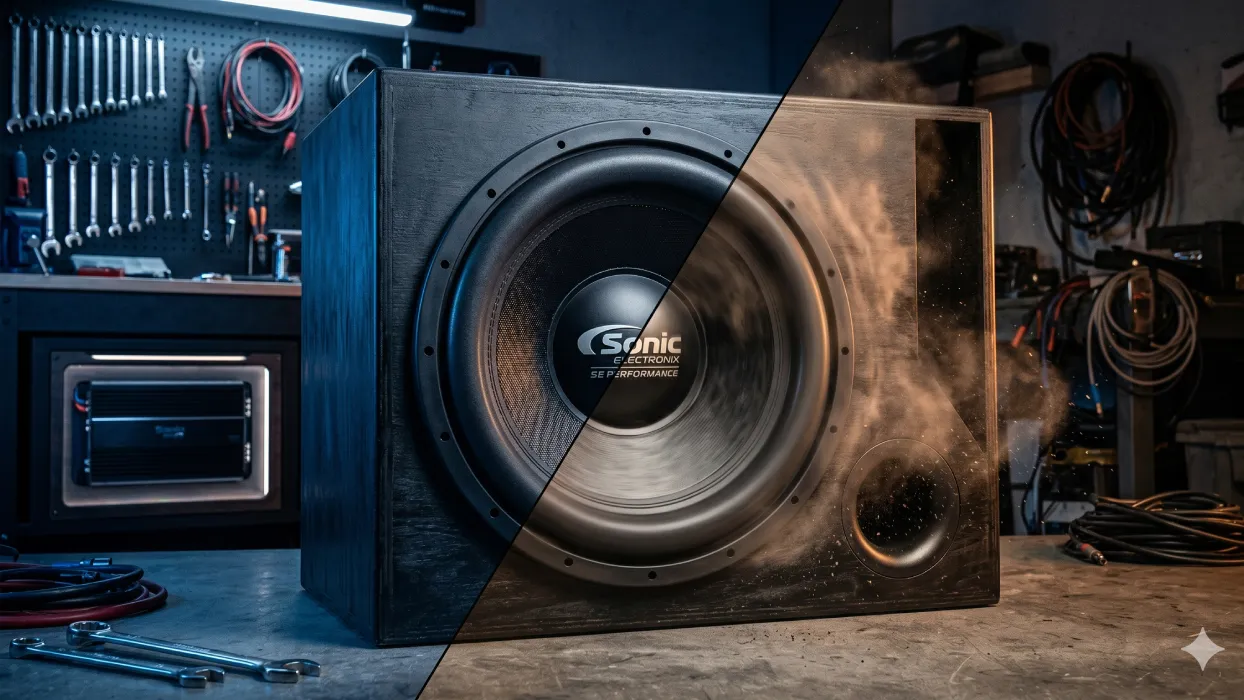
A boomy subwoofer is one of the most common complaints in car audio. Instead of a sharp, physical thud from a kick drum, you get a lingering, muddy drone that masks the rest of your music. While many enthusiasts blame the subwoofer itself, boominess is rarely a driver failure. It is almost always a system alignment problem – a conflict between the enclosure, the vehicle’s acoustics, and your crossover settings.
The Technical Difference: Transient Response vs. Resonance
Tight bass is defined by transient response, which is the ability of the subwoofer cone to start and stop exactly with the audio signal. Boomy bass occurs when the cone continues to resonate after the signal has ended. This ringing typically happens in a narrow frequency band, usually between 40Hz and 65Hz, creating a one-note bass effect where different songs all seem to produce the same muddy tone.
The Primary Causes of Boomy Bass
1. Incorrect Enclosure Matching
The box has more influence over the final sound than the subwoofer.
- Ported Enclosures: If a ported box is too small or tuned too high for the vehicle, it creates a massive output peak near the tuning frequency. This results in too much bass that lacks any musical texture or detail.
- Sealed Enclosures: While generally tighter, a sealed box that is too small for the driver will have a high Qtc (Total Quality Factor), causing the bass to sound punchy but hollow and restricted.
2. Crossover Overlap and Phase Issues
Boominess often occurs when the subwoofer and the door speakers are fighting over the same frequencies.
- The Overlap: If your subwoofer low-pass filter (LPF) is set to 100Hz and your door speakers are high-passed (HPF) at 60Hz, both sets of speakers are playing the 60Hz to 100Hz range.
- The Result: This creates a massive energy hump in the mid-bass region that sounds bloated. Furthermore, if the sub is out of phase with the doors, they will cancel each other out, leading the user to turn the sub up even louder to compensate, which only increases the boom.
3. Excessive Gain and Bass Boost
The Bass Boost knob is often the enemy of tight bass. Most bass boost circuits add a massive peak at 45Hz. This artificially inflates the most resonant part of the bass spectrum, leading to a loss of cone control and audible distortion that listeners perceive as mud.
4. Vehicle Cabin Gain
Every vehicle has a natural resonant frequency based on its interior dimensions. In most sedans and SUVs, the cabin naturally amplifies notes in the 40Hz to 50Hz range. If your enclosure tuning or EQ settings land exactly on this cabin gain peak, the system will sound boomy regardless of the equipment quality.
How to Achieve Tight, Precise Bass
Step 1: Calibrate Your Filters
To stop the overlap, start with a clean slate crossover strategy.
- Subwoofer LPF: Set this to 80Hz. This keeps the subwoofer from playing directional frequencies that should come from your dashboard.
- Door Speaker HPF: Set this to 80Hz. This relieves the smaller door speakers from trying to produce deep sub-bass, which they cannot control.
- The Goal: By stacking the filters at 80Hz, you create a seamless transition where the doors handle the high frequencies while the sub handles only the low frequencies.
Step 2: Kill the Boost, Use the EQ
Turn the Bass Boost on the amplifier to zero. If you have a Digital Signal Processor (DSP) or a head unit with a parametric EQ, look for the frequency that sounds the boomiest (usually around 45Hz to 55Hz) and apply a small cut of 2 to 3dB. Reducing the peak is always more effective than boosting the surrounding frequencies.
Step 3: Check Subwoofer Polarity
While the music is playing, flip the phase/polarity switch on your amplifier or head unit. Listen for which setting makes the bass feel like it is coming from the front of the car rather than the trunk. The setting that provides the most seamless blend with the door speakers is the correct one for a tight system.
Step 4: Mechanical Control (The Enclosure)
If the system is still boomy after tuning, the enclosure is likely the culprit.
- Seal the Box: For the tightest possible response, a sealed enclosure is the gold standard. It uses an air cushion to physically help the motor pull the cone back to center.
- Lower the Tuning: If you prefer a ported box, ensuring it is tuned to a lower frequency (32Hz to 35Hz) will usually move the peak out of the boomy mid-bass range and into the low-end foundation where it belongs.
Recommended Equipment for Accurate Bass
If you are building a system for sound quality and accuracy, we recommend drivers with high motor strength and low moving mass.
- NVX VCW Series: Engineered for a balance of high output and clinical accuracy.
- JL Audio W6/W7: Renowned for their ability to track complex bass lines without overhang.
- NVX SDK2 Sound Damping: Applying damping material to the trunk and rear deck reduces sympathetic resonance, which is often mistaken for boomy bass.
The Bottom Line
Tight bass is the result of a balanced system, not just a powerful one. By controlling your crossover points, eliminating artificial boosts, and ensuring your enclosure is properly matched to your vehicle, you can transform a muddy drone into a high-fidelity experience.
If you’re interested in looking for the best subwoofers for tight bass, check out our top picks here.
About The Authors

Benjie B.
Benjie has been writing automotive content for six years, and he loves the idea of democratizing knowledge through well-written and easy-to-understand content. He particularly enjoys the learning process behind writing and he’s fascinated by how vehicles and how the systems behind them work. Now, his work at Sonic Electronix has exposed him to the rabbit hole that is car audio systems, and he now wants to upgrade his family’s 20-year-old Toyota Yaris with a high-fidelity system someday. He enjoys watching content creators on YouTube, and he’s currently an avid cyclist, training so that his friends don’t leave him behind on group rides.

John Haynes
John is an industry veteran, with 35+ years in the mobile electronics industry. Starting as a floor salesperson for Al & Ed's Autosound, he became a top-seller using sales techniques acquired in prior industries. He successfully managed locations, and was the first "non-technician" to be MECP and MECP 1st Class certified. His stores were one of the few in the chain that did truly high-end systems. He left A&E to manage the SoCal territory for Clifford Electronics, then returned to Al & Ed's as the buyer. He quickly became the General Manager for the company, and served in that position for almost 20 years. He tried to retire during COVID, got bored and became the US Sales Manager for an aftermarket auto accessory company until his retirement in 2025.
John enjoys spending time with his wife, two children and three grandchildren and his dog, Kenny. He enjoys playing guitar and banjo, woodworking, photography and volunteers in his local hospital as well as the local baseball/softball complex. Of course, he stays involved in 12-Volt, as it's something that never leaves you once it's in the blood.
"I'm pleased to be working with the Sonic Electronix marketing team," says John. "Sonic is a premier e-tailer, and I'm happy to be involved with them."