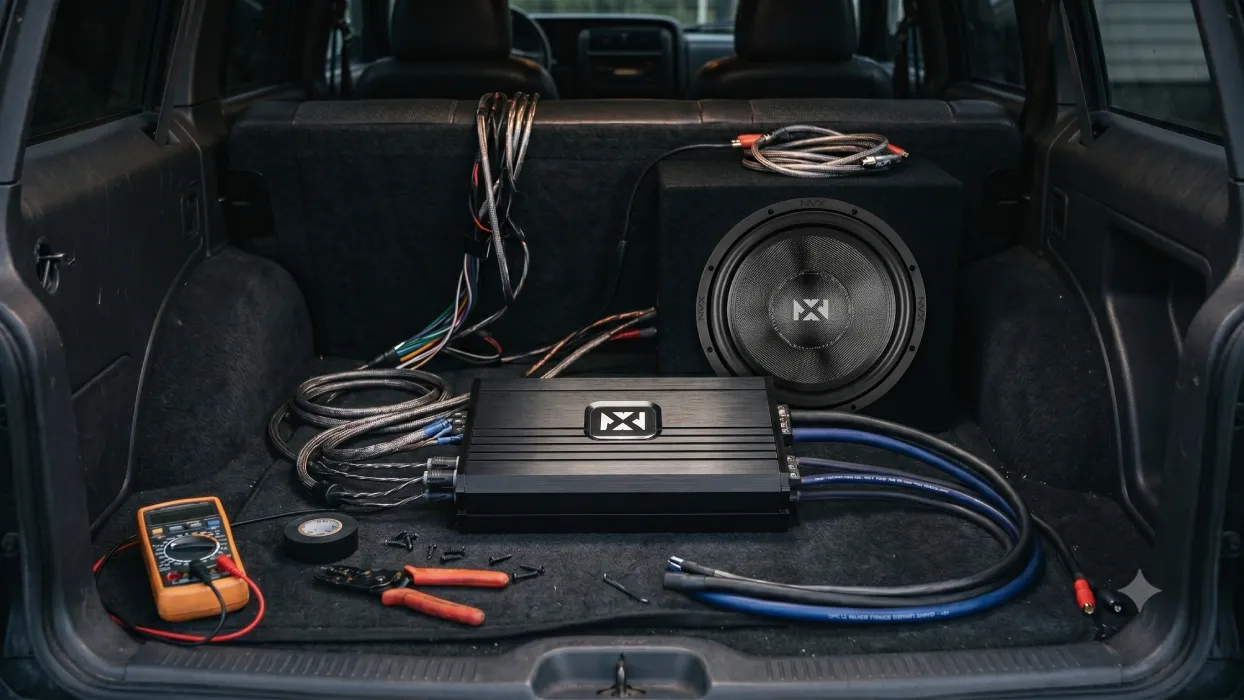
Your amp goes into protect mode to prevent permanent hardware failure from electrical or thermal stress. Your amplifier doesn’t randomly shut off. Rather, the internal monitoring circuit has likely detected a momentary violation of safe operating limits, such as a voltage drop below 10.5V, excessive heat soak, or an electrical short in the speaker wiring. It is a defensive shutdown designed to save the output transistors from melting.
What Are the Main Causes of Amplifiers Going Into Protect Mode?
Voltage Sag and Electrical Stress
Low voltage is the leading cause of random protection mode, especially during heavy bass notes. Amplifiers require a stable supply of 12.6V to 14.4V; when the vehicle’s electrical system cannot meet the current demand, voltage drops. This forces the amp to pull more amperage to maintain power, causing it to overheat or trigger an undervoltage shutdown.
- The Cause: Undersized power wire, a failing battery, or an overworked factory alternator.
- The Symptom: The amp cuts out only at high volumes or when the vehicle’s lights dim.
Impedance Mismatch and Shorts
Impedance is the electrical resistance your speakers present to the amplifier. If you wire subwoofers to a final load lower than the amp’s stable rating – such as wiring a 1-ohm load to a 2-ohm stable amp – the protection circuit will trip to prevent an overcurrent failure. Similarly, a stray wire strand touching the vehicle’s chassis creates a momentary short circuit that triggers an immediate shutdown.
- The Cause: Incorrect subwoofer wiring or a speaker wire pinched in a door hinge or seat rail.
- The Symptom: The amp enters protect mode instantly or at specific excursion levels where the wire moves.
Heat Soak and Thermal Clipping
Amplifiers generate heat as a byproduct of power conversion. If the heat sink cannot dissipate this energy faster than it is produced, the amp will hit a thermal ceiling. This is often exacerbated by clipping, which occurs when the gain is set too high, forcing the amp to produce a distorted signal that generates extreme internal heat.
- The Cause: Mounting the amp in an unventilated space or overdriving the input stage.
- The Symptom: The system plays fine for 20 minutes before shutting down, then resets once it cools.
High-Resistance Ground Connections
A poor ground connection is the most overlooked cause of system instability. The ground must be a short run of thick wire secured to the bare metal of the vehicle’s frame. If the connection is loose or bolted to a painted surface, it creates electrical resistance. This resistance generates heat at the terminal and prevents the amplifier from pulling the current it needs to stay active under load.
- The Cause: Grounding to a thin seat bolt, a painted surface, or using a loose crimp.
- The Symptom: The amp runs hot at the ground terminal and shuts off during moderately loud tracks.
How to Diagnose Amplifier Protect Mode Issues
Isolating the fault is faster than guessing. Follow this order of operations to determine if the problem is the amplifier or the environment:
- Disconnect Output: Unplug all speaker wires and RCA cables. If the amp stays in protect mode with nothing connected but power, ground, and remote, the internal hardware has failed.
- Test Signal: Reconnect only the RCAs. If the amp enters protect mode, the head unit or signal processor is sending a faulty or high-DC voltage signal.
- Check Loads: Reconnect speakers one at a time. The moment the amp cuts out, you have found the specified channel or speaker with the wiring short.
- Measure Voltage: Use a multimeter at the amplifier’s power terminals. If the voltage drops significantly while the music is playing, the issue is your vehicle’s power supply, not the amp.
Bottom Line: Protect mode is a safety feature, not a failure. By identifying whether the trigger is thermal, electrical, or a mechanical short, you can restore system stability without replacing functioning gear.
About The Authors

Benjie B.
Benjie has been writing automotive content for six years, and he loves the idea of democratizing knowledge through well-written and easy-to-understand content. He particularly enjoys the learning process behind writing and he’s fascinated by how vehicles and how the systems behind them work. Now, his work at Sonic Electronix has exposed him to the rabbit hole that is car audio systems, and he now wants to upgrade his family’s 20-year-old Toyota Yaris with a high-fidelity system someday. He enjoys watching content creators on YouTube, and he’s currently an avid cyclist, training so that his friends don’t leave him behind on group rides.

Christine F.
Christine is a dedicated content writer with over five years of experience covering a variety of automotive and car audio topics, transforming technical knowledge into compelling and easy-to-understand content. She’s passionate about writing articles that educate, empower, and inspire drivers and audio enthusiasts everywhere. In her free time, she enjoys playing tennis and going on walks with her dog.