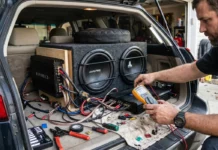
Your door speakers rattle more after an upgrade because the new speakers often produce more usable midbass and cleaner output, which causes loose door panels, clips, and parts inside the door to vibrate. Your original factory speakers likely didn’t create sound strong enough to vibrate these components.
A speaker upgrade rarely creates a rattle by itself. It usually reveals a weak mechanical interface in the door, such as a poor seal at the speaker.
Why Door Rattles Get Worse After a Speaker Upgrade
Upgraded speakers change two things:
First, they can produce more output in the 80–200 Hz range, this is the frequency where doors and panels can create more vibrations.
Second, new speakers tend to have less distortion than factory speakers. How can this make root rattles worse? Simple. Distortion can mask vibrations. When distortions disappear and your speakers sound cleaner, the small vibrations can sound more apparent.
Overall, your door and panels are a key part of the system. If the door isn’t stable and sealed, it turns into a vibrating radiator instead of a controlled enclosure.
If the Rattle Happens Only on Bass Notes
Likely Cause: Door Panel Clip Movement
A buzz that’s audible only when your speakers play specific bass notes is often a panel clip, trim interface, or screw boss vibrating at a particular frequency. These noises can sound like plastic chatter, especially around 80–150 Hz.
A quick confirmation method is to play a bass-heavy track at the same volume and press firmly on different sections of the door panel. If the rattle changes or stops when you apply pressure, it’s usually a panel interface issue.
Fix: Clip Replacement and Foam Isolation
A reliable fix usually includes two steps.
Replace damaged or loose door clips so the panel has proper clamp force again. Then add thin closed-cell foam at the contact points where plastic meets metal or plastic meets plastic. This foam doesn’t deadening the door. It prevents hard surfaces from vibrating against each other.
If you only add damping material to the metal and ignore the panel interfaces, the rattle often returns.
If the Rattle Gets Worse as Volume Increases
Likely Cause: Poor Speaker Seal and Door Resonance
If the noise scales with volume, the door is often reacting to air leaks and vibration created by the speaker’s midbass output.
Two common installation issues cause this:
- The speaker isn’t sealed to the mounting surface, so front-wave and rear-wave air interact and create turbulence
- The mounting adapter ring flexes, which lets the speaker move energy into the door instead of into the cabin
When the seal is poor, you can get rattles and weaker midbass at the same time. That combination is a strong clue.
Fix: Gasket, Baffle, and Treatment Strategy
Start with the mechanical foundation before adding heavy treatment.
Seal the speaker to the mounting surface using speaker gasket tape or a foam ring so air can’t leak around the frame. Confirm the adapter ring sits flat and doesn’t rock.
If the door metal is thin or “rings” when tapped, targeted butyl damping on the outer door skin helps. The goal isn’t covering every inch. It’s reducing resonance where the panel flexes most.
For a controlled result, use a butyl mat for the metal and closed-cell foam for panel interfaces. NVX-style damping and foam solutions fit this approach because they address both resonance and contact noise without treating the door like a subwoofer enclosure.
If the Rattle Sounds Metallic
Likely Cause: Window Track or Harness Contact
A metallic tick, tap, or clank often comes from something inside the door cavity.
Common sources include:
- Wiring harnesses contacting the inner door skin
- Window tracks or rods vibrating under midbass load
- Loose fasteners or clip-in parts near the latch area
These noises can appear suddenly after a speaker upgrade because the new speaker’s midbass is physically shaking the door harder.
Fix: Tie-Downs and Clearance Checks
Remove the door panel and inspect the cavity with the window raised and lowered. You’re looking for anything that can contact metal when the door vibrates.
Secure wiring with cloth tape and tie-downs so it can’t slap the door skin. Add small foam pads where parts sit close together. Confirm fasteners on the window track and regulator are tight to factory spec.
If the rattle changes when the window is at a specific height, it’s often a clearance or regulator-related issue.
If the Speaker Itself Buzzes
Likely Cause: Mounting Ring Flex or Fastener Torque
If the sound seems to come directly from the speaker area, it’s commonly a mounting problem rather than a defective driver.
Buzzing can come from:
- An adapter ring that flexes under load
- Screws that aren’t evenly tightened, warping the speaker frame
- A speaker that isn’t seated flat due to interference behind it
Uneven torque matters because it can distort the basket alignment, which creates vibration and noise at certain frequencies.
Fix: Reinforced Rings and Proper Torque Pattern
Use a rigid mounting adapter and confirm it’s secured firmly to the door metal. Then mount the speaker using an even tightening pattern, similar to tightening lug nuts.
Add gasket tape between the speaker and ring, and between the ring and door. This improves sealing and reduces vibration transfer.
If clearance behind the speaker is tight, confirm the magnet and terminals aren’t contacting the window mechanism or inner skin.
If the Sound Is Distortion, Not Rattle
Likely Cause: Clipping or No High-Pass Filter
Not all rattles are mechanical. Distortion can sound like buzz, crunch, or harsh vibration, especially in the midbass.
Common causes include:
- Amplifier gain set too high, causing clipping
- No high-pass filter, forcing door speakers to play deep bass
- Aggressive EQ boosts in the 60–120 Hz range
Door speakers usually need a high-pass filter because the door isn’t a sealed sub enclosure and midbass drivers have limited excursion.
Fix: Gain Reset and Filtering
Set your crossovers before you touch EQ.
Apply a high-pass filter to the door speakers so they aren’t asked to reproduce sub-bass. Then reduce any large bass boosts and re-check the noise.
After filtering is correct, reset gains so the amp reaches your target volume without audible strain. If the noise disappears when you lower the volume slightly, clipping is a strong possibility.
When Sound Treatment Is the Correct Next Step
Sound treatment makes sense when the speaker is mounted and sealed correctly, the door panel is secured, and you still hear resonance or panel vibration under midbass load.
At that point, targeted treatment is a performance tool:
- Butyl damping reduces metal resonance
- Closed-cell foam reduces interface buzzes
- Sealing strategies improve midbass efficiency and reduce turbulence noise
If your goal is cleaner midbass and fewer rattles, treating the door is often a more meaningful upgrade than buying a different speaker.
How to Fix Door Rattle Without Guessing
A reliable order of operations prevents repeated tear-downs.
Start with panel clips and contact points, then confirm the speaker seal and mounting rigidity, then secure anything that can move inside the door, and only then add damping where the door flexes most. Finish by verifying crossover and gain settings so distortion isn’t being mistaken for rattle.
When the door is mechanically stable and the speaker is properly filtered, upgrades usually sound stronger and cleaner without bringing new noises along with them.
About The Authors

Benjie B.
Benjie has been writing automotive content for six years, and he loves the idea of democratizing knowledge through well-written and easy-to-understand content. He particularly enjoys the learning process behind writing and he’s fascinated by how vehicles and how the systems behind them work. Now, his work at Sonic Electronix has exposed him to the rabbit hole that is car audio systems, and he now wants to upgrade his family’s 20-year-old Toyota Yaris with a high-fidelity system someday. He enjoys watching content creators on YouTube, and he’s currently an avid cyclist, training so that his friends don’t leave him behind on group rides.

John Haynes
John is an industry veteran, with 35+ years in the mobile electronics industry. Starting as a floor salesperson for Al & Ed's Autosound, he became a top-seller using sales techniques acquired in prior industries. He successfully managed locations, and was the first "non-technician" to be MECP and MECP 1st Class certified. His stores were one of the few in the chain that did truly high-end systems. He left A&E to manage the SoCal territory for Clifford Electronics, then returned to Al & Ed's as the buyer. He quickly became the General Manager for the company, and served in that position for almost 20 years. He tried to retire during COVID, got bored and became the US Sales Manager for an aftermarket auto accessory company until his retirement in 2025.
John enjoys spending time with his wife, two children and three grandchildren and his dog, Kenny. He enjoys playing guitar and banjo, woodworking, photography and volunteers in his local hospital as well as the local baseball/softball complex. Of course, he stays involved in 12-Volt, as it's something that never leaves you once it's in the blood.
"I'm pleased to be working with the Sonic Electronix marketing team," says John. "Sonic is a premier e-tailer, and I'm happy to be involved with them."