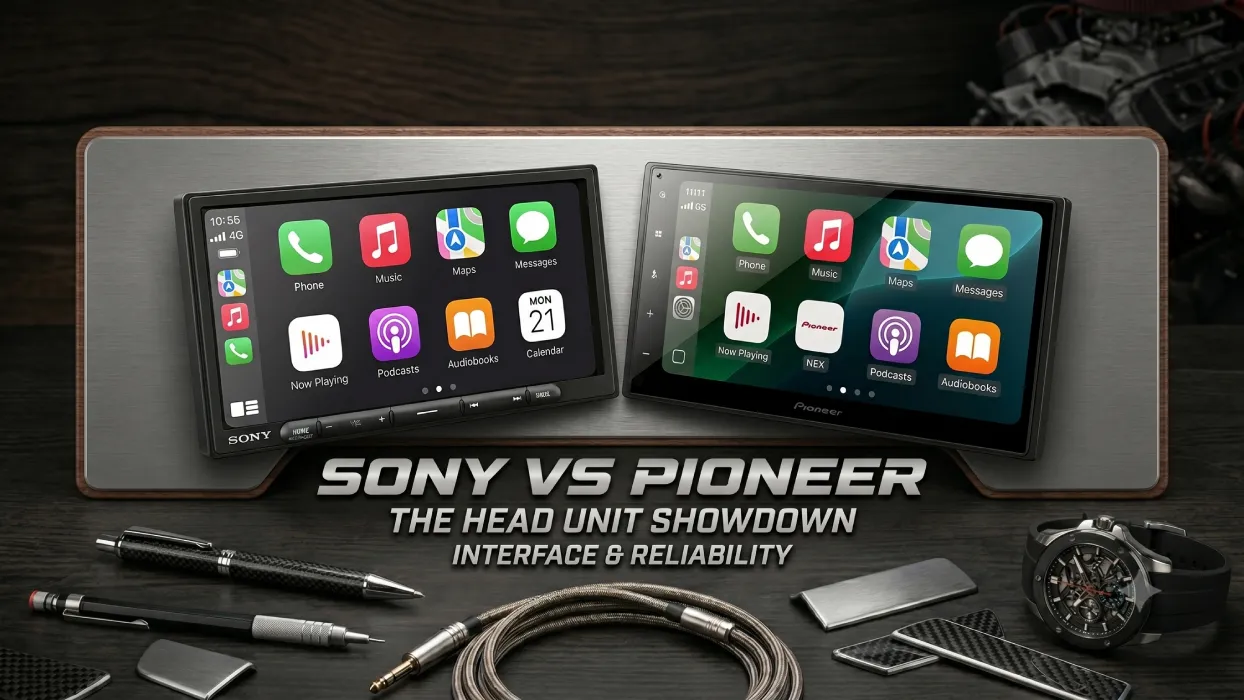
The choice between Pioneer and Sony head units is a battle between Pioneer’s deep feature sets and Sony’s streamlined user experience. Pioneer offers extensive audio customization and multi-layered menus through its Networked Entertainment Experience (NEX) platform, while Sony focuses on minimalism, physical controls, and industry-leading boot times.
Both brands maintain high standards for reliability, but Pioneer generally appeals to users who want to tweak their system, while Sony targets those who want the stereo to have easy and seamless use.
Which Head Unit Has Better User Interface?
Pioneer and Sony take polar opposite approaches to designing their user interface (UI). If you enjoy a highly customizable home screen and deep sub-menus for fine-tuning every aspect of the audio signal, Pioneer is the more natural fit. However, if you find multi-layered menus distracting while driving and want a simpler UI, Sony’s approach is often preferred.
Sony: Minimalist Logic
Sony’s UI is designed around high-contrast, oversized icons and a flat menu structure. There are rarely more than two taps required to reach any major setting. This simplicity extends to their physical design; Sony is one of the few remaining manufacturers that consistently includes tactile buttons or a volume knob on many of its XAV-series models. This focus on ergonomics makes the unit easier to operate by feel rather than sight.
Pioneer: NEX Experience
Pioneer’s NEX interface is feature-rich and visually dense. It allows for more complex multitasking and deeper integration with external sources. While the interface can feel more sophisticated, it also has a steeper learning curve. Users who aren’t tech-savvy might find the number of icons and settings overwhelming during the initial setup phase.
System Performance and Boot Speeds
Sony is the industry benchmark for boot speed. Most Sony XAV models feature a Quick Wake circuit that allows the unit to initialize almost the instant the ignition is turned. In many cases, the system is fully operational in under five seconds.
Pioneer units, particularly the higher-end NEX models with built-in navigation or complex operating systems, typically take longer to boot. You might find yourself waiting 10 to 15 seconds for the system to fully handshake with your smartphone for wireless CarPlay or Android Auto. While this isn’t a hardware failure, the lag can feel like a reliability issue to a user accustomed to the instant-on nature of factory electronics.
Long-Term Reliability and Hardware Build
Reliability in a car stereo is measured by its ability to handle extreme temperature fluctuations, vibration, and software stability over several years.
- Software Stability: Sony’s simplified operating system tends to be more stable over time. Because there are fewer moving parts in the software code, glitches and random reboots are less common.
- Mechanical Durability: Pioneer has a long history of robust mechanical engineering, particularly in their motorized flip-out screens and disc-loading mechanisms. However, as the industry moves toward mechless designs without CD players, this advantage is less pronounced.
- Thermal Management: Both brands use high-quality heat sinks, but Pioneer units often include internal fans on their high-power models. This is a double-edged sword; the fan provides better cooling for the internal amplifier, but it’s also a mechanical part that can eventually collect dust or fail after years of use.
Audio Tuning and Signal Chain
If you’re building a high-end system with external amplifiers and a digital signal processor (DSP), the way these head units handle the audio signal is the deciding factor.
| Feature | Pioneer (NEX Series) | Sony (XAV/ES Series) |
| Graphic EQ | 13-Band (Typical) | 10-Band (Typical) |
| Crossover Control | Highly Detailed / 3-Way Mode | Standard High/Low Pass |
| Preout Voltage | Typically 4V | 5V (on ES models) |
| Time Alignment | Manual & Auto (with mic) | Manual |
Pioneer is the clear winner for the audiophile tweaker. Their units often include a 3-way mode which allows you to run a fully active front stage with tweeters, mids, and subwoofers directly from the head unit’s crossovers. Sony, conversely, focuses on the quality of the signal rather than the quantity of the processing. Their Mobile ES line uses high-end digital-to-analog converters (DAC) to ensure the signal remains as clean as possible before it reaches your amplifiers.
Head Units From Pioneer and Sony You Should Check Out
When choosing between these two legacy brands, match the model to your specific installation depth and tuning needs.
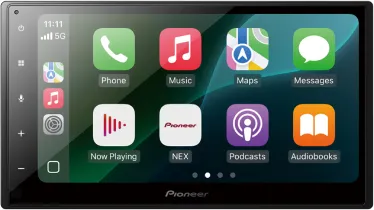
Pioneer DMH-1800NEX
As a reliable efficiency pick, the DMH-1800NEX serves as a stable entry point for a modern dash upgrade. It features a shallow-chassis, mechless design that makes it easy to install in dashboards with restricted depth. It provides a consistent wired CarPlay and Android Auto experience without the overhead of more complex wireless protocols, making it a robust choice for a first-time builder.
Sony XAV-AX4000
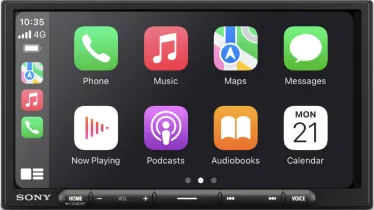
The XAV-AX4000 is a standout for reliability and ease of use. It features Sony’s Quick Wake technology and a physical button bar for immediate access to volume and track controls. It also supports wireless smartphone integration and includes a high-voltage preout, making it a stable foundation for an amplified system.
About The Authors

Benjie B.
Benjie has been writing automotive content for six years, and he loves the idea of democratizing knowledge through well-written and easy-to-understand content. He particularly enjoys the learning process behind writing and he’s fascinated by how vehicles and how the systems behind them work. Now, his work at Sonic Electronix has exposed him to the rabbit hole that is car audio systems, and he now wants to upgrade his family’s 20-year-old Toyota Yaris with a high-fidelity system someday. He enjoys watching content creators on YouTube, and he’s currently an avid cyclist, training so that his friends don’t leave him behind on group rides.

John Haynes
John is an industry veteran, with 35+ years in the mobile electronics industry. Starting as a floor salesperson for Al & Ed's Autosound, he became a top-seller using sales techniques acquired in prior industries. He successfully managed locations, and was the first "non-technician" to be MECP and MECP 1st Class certified. His stores were one of the few in the chain that did truly high-end systems. He left A&E to manage the SoCal territory for Clifford Electronics, then returned to Al & Ed's as the buyer. He quickly became the General Manager for the company, and served in that position for almost 20 years. He tried to retire during COVID, got bored and became the US Sales Manager for an aftermarket auto accessory company until his retirement in 2025.
John enjoys spending time with his wife, two children and three grandchildren and his dog, Kenny. He enjoys playing guitar and banjo, woodworking, photography and volunteers in his local hospital as well as the local baseball/softball complex. Of course, he stays involved in 12-Volt, as it's something that never leaves you once it's in the blood.
"I'm pleased to be working with the Sonic Electronix marketing team," says John. "Sonic is a premier e-tailer, and I'm happy to be involved with them."