Summary
- A subwoofer converts electrical energy into physical movement using its voice coil, magnet, and cone assembly.
- Low frequencies require greater cone excursion and stronger motor control than midrange or treble.
- The enclosure and amplifier determine how accurately the subwoofer can move air and reproduce bass.
A subwoofer plays the lowest part of the audible spectrum, but its behavior is the result of a coordinated mechanical and electrical process. When you understand how a subwoofer works, it becomes easier to see why enclosure type, power handling, and tuning matter so much to the final result.
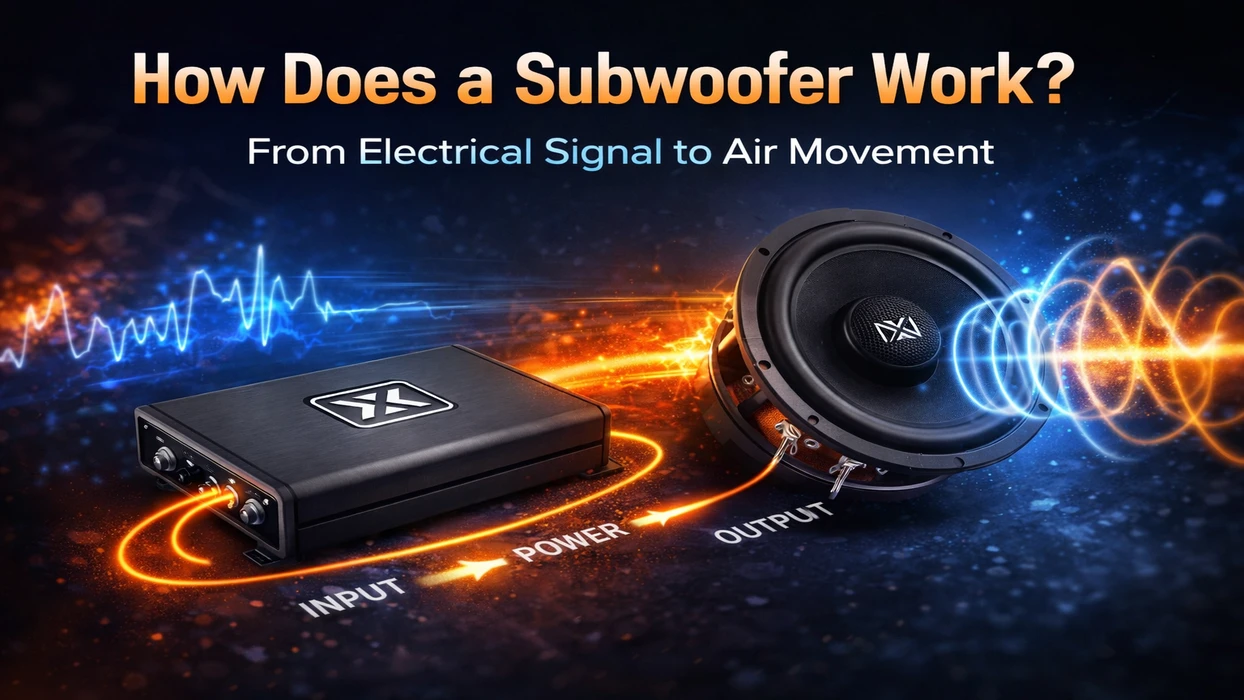
A subwoofer reproduces low-frequency sound by using both electrical and mechanical energy. The amplifier sends an electrical signal to the subwoofer, which then converts it into motion. That motion pushes and pulls air, creating the deep tones we associate with bass.
In summary, here’s the basic flow of how a subwoofer creates sound:
Amplifier Signal → Voice Coil → Magnetic Interaction → Cone Motion → Air Pressure Waves → Enclosure Control → Listener Experience
From Electrical Signal to Physical Motion
Every subwoofer begins its work the moment it receives a low-frequency signal from the amplifier. This signal, sent through the speaker wires, is an alternating electrical current that represents the bass portion of the music. The current flows into the subwoofer’s voice coil, which is a tightly wound copper wire wrapped around a former, a lightweight cylindrical support tube that keeps the coil perfectly centered inside the motor assembly.
As the amplifier’s output changes with the rhythm of the music, the voltage inside the coil fluctuates in perfect sync, forming the foundation of motion that later becomes audible sound.
The Interaction Between Voice Coil and Magnet
Inside the motor assembly, the subwoofer’s voice coil sits in the magnetic gap of a powerful permanent magnet. When the alternating current flows through the coil, it generates a magnetic field that changes direction with the signal. This new field interacts with the permanent magnet’s field, creating a continuous push-pull force on the coil. These opposing magnetic forces are what set the cone in motion.
The stronger and cleaner the electrical signal from the amplifier, the more precise and controlled this magnetic interaction becomes, allowing the subwoofer to reproduce the original waveform of the music accurately and with minimal distortion.
Cone and Suspension Assembly Movements
The voice coil is firmly bonded to the back of the subwoofer’s cone, also called the diaphragm. When the coil moves within the magnetic gap, the cone follows, moving forward and backward in sync with the audio signal.
The speaker’s suspension components include the spider (a woven disk) and the surround (a flexible ring around the cone’s edge). These components hold the cone in alignment while allowing smooth motion. This assembly ensures that the cone can travel freely without tilting or rubbing against the frame. The cone’s movement displaces air in front of and behind it, beginning the process of turning electrical motion into physical sound pressure.
The size of the cone and the amount it can move, known as excursion, determine how much air the subwoofer can push and how deep the bass will sound.
Interaction Between the Voice Coil and Air
As the cone moves forward, it compresses air molecules, creating an area of higher pressure called compression. When it moves backward, it creates an area of lower pressure called rarefaction. These alternating pressure zones form sound waves that travel through the air as vibrations. Low-frequency sound waves are much longer than midrange or treble frequencies, which is why they can fill a vehicle cabin and even be felt physically. This stage is where the invisible electrical energy from the amplifier transforms into something tangible, the deep, rhythmic motion of air that we recognize as bass.
The Subwoofer Enclosure’s Effects
The enclosure that houses the subwoofer determines how efficiently this air movement is managed. In a sealed enclosure, the trapped air acts like a spring, keeping the cone under tight control and producing clean, accurate bass that is easy to blend with door speakers. A ported enclosure uses a tuned vent to boost output at specific frequencies, creating louder and deeper bass with less amplifier power. A bandpass enclosure combines both designs by allowing sound to pass only through a tuned ported chamber, resulting in extreme efficiency but a narrower frequency range. Choosing the right enclosure is as important as choosing the subwoofer itself, since it defines the overall sound character: tight and precise, deep and powerful, or focused and punchy.
Listener Perception
Finally, the sound waves produced by the moving cone and shaped by the enclosure reach your ears as low-frequency audio. Because bass is felt as much as it is heard, the listener perceives these vibrations as fullness, impact, and depth in the music. The goal of a well-designed subwoofer system is not just to produce loud bass, but to deliver controlled, dynamic, and musical low-frequency response. When the amplifier, subwoofer, and enclosure work together in harmony, the result is bass that integrates naturally with the rest of your sound system and adds realism to music.
About The Authors

Benjie B.
Benjie has been writing automotive content for six years, and he loves the idea of democratizing knowledge through well-written and easy-to-understand content. He particularly enjoys the learning process behind writing and he’s fascinated by how vehicles and how the systems behind them work. Now, his work at Sonic Electronix has exposed him to the rabbit hole that is car audio systems, and he now wants to upgrade his family’s 20-year-old Toyota Yaris with a high-fidelity system someday. He enjoys watching content creators on YouTube, and he’s currently an avid cyclist, training so that his friends don’t leave him behind on group rides.

Hunter V.
Hunter is a Tech Support Lead at Sonic Electronix who also works with the company’s marketing and R&D team. With eight years of experience in the car audio installation space, Hunter likes to make sure that our customers are always happy with their purchase. In his past time, Hunter enjoys building subwoofers and spending time with his kids.