Summary
- Marine subwoofers use UV-resistant materials to prevent cone, surround, and grille degradation from direct sunlight.
- Salt exposure accelerates corrosion, so marine models use coated hardware, sealed motors, and corrosion-resistant terminals.
- Moisture resistance is critical. Marine subwoofers are designed to handle splashing, humidity, and condensation without internal damage.
- A standard car subwoofer may work briefly in a marine environment, but long-term reliability depends on marine-specific construction.
What Makes a Marine Subwoofer Different?
A marine subwoofer isn’t just a car subwoofer with a different label. It is designed for an environment that is far more aggressive than the interior of a vehicle.
On a boat, side by side, or in an open-air vehicle, the subwoofer is exposed to direct sunlight, water spray, humidity, and often salt. These conditions break down materials quickly. A conventional car subwoofer may sound fine at first, but it is not built to survive this kind of exposure over time.
The differences come down to three main threats: ultraviolet radiation, salt corrosion, and moisture intrusion.
UV Exposure: Sunlight Is More Destructive Than It Looks
Ultraviolet radiation is one of the fastest ways to destroy a speaker. Sunlight breaks down plastics, rubber, adhesives, and coatings. In a vehicle cabin, this exposure is limited. On a boat, the subwoofer may sit in direct sunlight for hours. If the boat is left on open water, then it’s going to be in direct sunlight its entire life.
Marine subwoofers use UV-stabilized materials throughout the design.
The cone material is usually polypropylene or a composite that resists fading and brittleness. Paper cones, even treated ones, degrade quickly when exposed to UV light. They dry out, lose stiffness, and eventually crack.
Marine surround speaker materials are also critical. Marine surrounds are typically rubber compounds formulated to resist UV damage. Standard foam surrounds can deteriorate rapidly in sunlight, leading to air leaks and reduced excursion control.
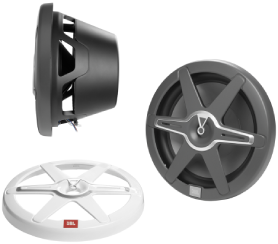
Grilles and trim pieces are made from UV-resistant plastics or coated metals. Without this protection, grilles discolor, weaken, and eventually become brittle enough to break.
UV resistance does not improve sound quality. It preserves the mechanical integrity of the subwoofer so it continues to perform the same way over time.
Salt Exposure: Corrosion Is the Silent Killer
Salt air is extremely corrosive. Even when a speaker never gets splashed, salt carried in the air settles on metal parts and accelerates oxidation. This is especially true in coastal and offshore environments.
Marine subwoofers address this with corrosion-resistant construction.
The basket is often made from coated steel, aluminum, or composite materials that resist rust. Bare steel baskets, common in car subwoofers, can corrode quickly in marine conditions.
The motor assembly is sealed more aggressively. Exposed back plates and venting designs that work fine in a car can allow salt-laden air to reach the voice coil and magnet structure. Over time, this leads to rust, reduced magnetic strength, and voice coil failure.
Terminals are another weak point. Marine subwoofers use stainless steel, brass, or plated terminals to prevent corrosion. Standard push terminals can oxidize, increasing resistance and eventually causing intermittent signal loss.
Salt damage rarely causes immediate failure. It slowly degrades performance until output drops or the subwoofer fails completely.
Moisture Resistance: It Is Not Just About Getting Wet
Moisture is unavoidable in marine environments. Even if a subwoofer never sees direct water spray, humidity and condensation are constant.
Marine subwoofers are designed to tolerate moisture without absorbing it.
Cones are non-porous, so they do not swell or soften when exposed to water. The adhesives used to bond the cone, surround, and spider are moisture-resistant, preventing separation over time.
The spider material is also treated differently. In car subwoofers, untreated cloth spiders can absorb moisture, changing stiffness and causing long-term performance issues. Marine spiders are coated to resist water absorption.
Voice coils and lead wires are insulated to reduce corrosion and electrical breakdown. While marine subwoofers are not fully waterproof unless specifically rated, they are built to survive splashing, rain, and heavy humidity without internal damage.
This matters because moisture-related failures often appear as distortion, rubbing, or reduced output long before the subwoofer stops working entirely.
Why Car Subwoofers Fail in Marine Environments
A common question is whether a regular car subwoofer can be used on a boat. Technically, it can. Practically, it shouldn’t.
Car subwoofers are designed for climate-controlled interiors. They assume limited UV exposure, minimal moisture, and no salt in the air. When placed in a marine environment, several things tend to happen.
- The surround hardens or cracks from sun exposure.
- The cone fades, weakens, or delaminates.
- Metal parts begin to corrode.
- Electrical connections oxidize.
- Adhesives fail due to moisture cycling.
The subwoofer can still play sound, but its performance becomes inconsistent and its lifespan shortens dramatically.
Sound Quality Differences: Not the Primary Goal
Marine subwoofers are not inherently louder or deeper than car subwoofers. Their design focus is durability first, predictable performance second.
Because marine systems often operate in open-air environments, enclosure design and placement have a greater impact on bass output than the subwoofer itself. Many marine subs are optimized for infinite baffle or sealed applications where space is limited and airflow is uncontrolled.
The goal is reliable, repeatable bass that holds up over time, not maximum output in ideal conditions.
When Does a Marine Subwoofer Makes Sense
A marine subwoofer is the correct choice when the system will be exposed to any of the following:
- Direct sunlight
- Open air or partial enclosures
- High humidity or frequent condensation
- Saltwater or coastal environments
This includes boats, side-by-sides, UTVs, Jeeps with open tops, and outdoor audio installations.
Using a marine-rated subwoofer in a car is usually unnecessary, but using a car subwoofer in a marine environment is almost always a compromise.
Final Thoughts
The difference between a marine subwoofer and a car subwoofer is not marketing. It is material science and environmental engineering.
If the system lives outdoors, these features are not optional. They are the reason the subwoofer continues to work years later instead of failing prematurely.
A marine subwoofer is built for survival first. Sound quality follows when the design remains intact.
About The Authors

Benjie B.
Benjie has been writing automotive content for six years, and he loves the idea of democratizing knowledge through well-written and easy-to-understand content. He particularly enjoys the learning process behind writing and he’s fascinated by how vehicles and how the systems behind them work. Now, his work at Sonic Electronix has exposed him to the rabbit hole that is car audio systems, and he now wants to upgrade his family’s 20-year-old Toyota Yaris with a high-fidelity system someday. He enjoys watching content creators on YouTube, and he’s currently an avid cyclist, training so that his friends don’t leave him behind on group rides.

Dustin H.
Dustin is passionate about delivering honest car audio advice that serves both first-time buyers and seasoned car audio enthusiasts. A veteran of the car audio industry, he continues to learn about car audio space while building some systems of his own. Outside of his work in car audio, he’s active in his local church and enjoys spending time with family.