If your factory system loses bass as you turn the volume up, you’re dealing with OEM bass roll-off. If your system keeps its bass but sounds thin or lacks impact, you’re dealing with bass shaping and integration limits.
The NVX XBBR2 and AudioControl LC2i both address factory integration, but they solve slightly different problems. The right choice depends on whether you need automatic roll-off correction or adjustable bass processing with built-in load control.
Key Takeaways:
- LC2i is purpose-built for factory bass roll-off correction using AccuBASS, a bass restoration circuit that counteracts factory radio systems which reduce bass output at higher volumes.
- The NBX XBBR2 combines line output conversion with adjustable bass processing.
- The NVX XBBR2 also includes selectable load resistance, which can prevent OEM radio shutdown issues.
- Both provide high-voltage RCA outputs (preouts = RCA outputs feeding an external amplifier) for clean amplifier gain structure.
Note: Line output converters (LOCs) turn high-level speaker signals from a factory radio into low-level RCA preamp signals required by aftermarket amplifiers.
Understanding how each unit restores bass explains which one fits your vehicle.
Why Bass Roll-Off Happens in Factory Systems
Many OEM radios reduce low-frequency output as volume increases. Manufacturers do this to protect small factory speakers and prevent distortion complaints.
That means your subwoofer may sound strong at low volume, then fade or thin out at higher levels.
A bass restoration device works by either:
- Detecting that roll-off behavior and correcting it automatically, or
- Allowing you to manually shape the low-frequency signal before it reaches the amplifier.
The LC2i focuses on the first method. The XBBR2 gives you more control over the second.
Quick Comparison
| Feature | NVX XBBR2 | AudioControl LC2i |
|---|---|---|
| Primary Design Goal | LOC + adjustable bass processing | LOC + automatic roll-off correction |
| Bass Correction Method | Parametric bass control (adjustable frequency and width) | AccuBASS threshold-based roll-off restoration |
| Load Handling | Selectable load switch for OEM compatibility | Fixed input impedance |
| Outputs | Single RCA output pair | Dual outputs (main + bass) |
Both units provide strong signal voltage for amplifiers. The difference is how they restore and shape bass.
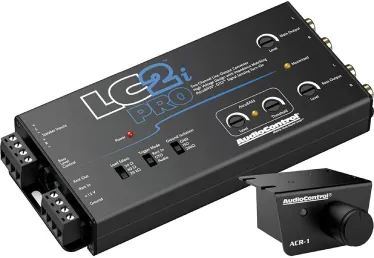
AudioControl LC2i: Targeted Roll-Off Correction
The LC2i’s defining feature is AccuBASS, which activates when it detects factory bass reduction above a user-set volume threshold.
Why that matters:
When roll-off occurs dynamically, a fixed bass boost won’t track it properly. AccuBASS monitors the signal and restores bass only when the reduction happens.
That makes the LC2i a clean solution when:
- Bass clearly drops as volume rises
- The factory head unit behavior is consistent
- You want minimal ongoing tuning
Its dual outputs also help in multi-amplifier systems where you’re feeding both a sub amp and another processor or amplifier.
The trade-off is limited manual bass shaping flexibility compared to a parametric processor.
NVX XBBR2: Controlled Bass Shaping With Integration Flexibility
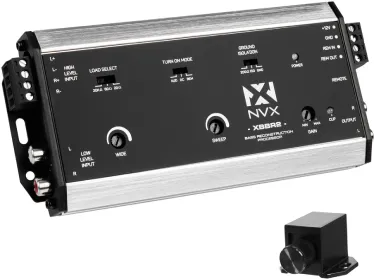
The NVX XBBR2 combines line output conversion with adjustable bass processing, allowing you to select the center frequency and bandwidth of the enhancement.
This matters because not all factory bass issues are simple roll-offs. Some systems have uneven frequency response or weak low-end structure. Adjustable bass processing lets you reinforce the sub-bass region without inflating the upper bass.
The XBBR2 also includes a selectable load switch. Some factory radios expect to see a speaker load. If they don’t, they may mute, distort, or throw diagnostic errors. The built-in load options help prevent those integration problems.
This makes the XBBR2 especially practical when:
- OEM radios behave unpredictably after speaker removal
- You want more tuning flexibility
- You prefer having a remote bass control included
From a system-design perspective, that added integration flexibility can reduce troubleshooting time during installation.
Output Voltage and Gain Structure
Both units provide strong preout voltage.
Higher preout voltage matters because it allows:
- Lower amplifier gain settings
- Reduced noise floor
- Cleaner signal-to-noise performance
In real vehicles, proper gain structure often impacts sound quality more than small spec differences between processors.
Which One Makes More Sense?
Choose the AudioControl LC2i if:
- Your bass clearly drops at higher volume levels
- You want automatic roll-off correction
- You’re running multiple amplifiers from the same processor
Choose the NVX XBBR2 if:
- You want adjustable bass shaping control
- You need selectable load resistance for OEM compatibility
- You prefer integrated remote level control
- You want flexibility to tune the low-frequency focus more precisely
From a design standpoint, the LC2i solves a specific OEM behavior. The XBBR2 solves integration plus tuning flexibility in one chassis.
Real-World System Guidance
In many daily-driver upgrades, the issue isn’t extreme roll-off. It’s uneven factory tuning combined with limited integration flexibility.
That’s where a processor like the NVX XBBR2 often fits well. It gives you control over frequency focus while handling OEM signal quirks.
If you’ve confirmed strong dynamic roll-off behavior in your vehicle, the LC2i’s AccuBASS system directly addresses that condition.
Neither unit is universally better. Each fits a different integration goal.
The right choice depends on how your factory radio behaves and how much tuning control you want after installation.
About The Authors

Benjie B.
Benjie has been writing automotive content for six years, and he loves the idea of democratizing knowledge through well-written and easy-to-understand content. He particularly enjoys the learning process behind writing and he’s fascinated by how vehicles and how the systems behind them work. Now, his work at Sonic Electronix has exposed him to the rabbit hole that is car audio systems, and he now wants to upgrade his family’s 20-year-old Toyota Yaris with a high-fidelity system someday. He enjoys watching content creators on YouTube, and he’s currently an avid cyclist, training so that his friends don’t leave him behind on group rides.

Norman R.
Norman is a Senior Tech Support and Test Bench Representative for Sonic Electronix, with over 25 years of experience in building car audio systems. He enjoys working with car audio and the opportunity to showcase various products to potential customers. He also finds joy in working with the R&D team, as he gets to see future products and the company’s growth. A hot-rodder and basshead through and through, Norman is extremely passionate about fast, loud, and low cars. In his spare time, he frequently attends car shows and builds big stereos and hot rods. He hopes to one day pass on his skills and knowledge to his son.