Summary
- Vehicle acoustics greatly influence how subwoofers sound, often more than the brand or size itself.
- Trunk vehicles isolate bass energy, requiring more power and venting to achieve full sound.
- Hatchbacks and SUVs allow direct cabin coupling, resulting in stronger, more immediate bass.
- Enclosure placement and cabin shape determine how efficiently low frequencies travel through the vehicle.
- Understanding your vehicle’s acoustic behavior helps you tune your system for cleaner, more consistent bass.
When you install a subwoofer, the vehicle becomes part of the sound system. Every interior surface like the trunk panels, glass, and dashboard affects how low frequencies behave. The same subwoofer can sound powerful in one car and weak in another simply because of the cabin layout.
The challenge is that bass waves are long and sensitive to reflections, boundaries, and air volume. A car’s structure defines how these waves build up, reinforce, or cancel each other. Knowing how your vehicle interacts with low frequencies lets you design a system that sounds balanced and controlled rather than uneven or boomy.
Why Vehicle Acoustics Matter
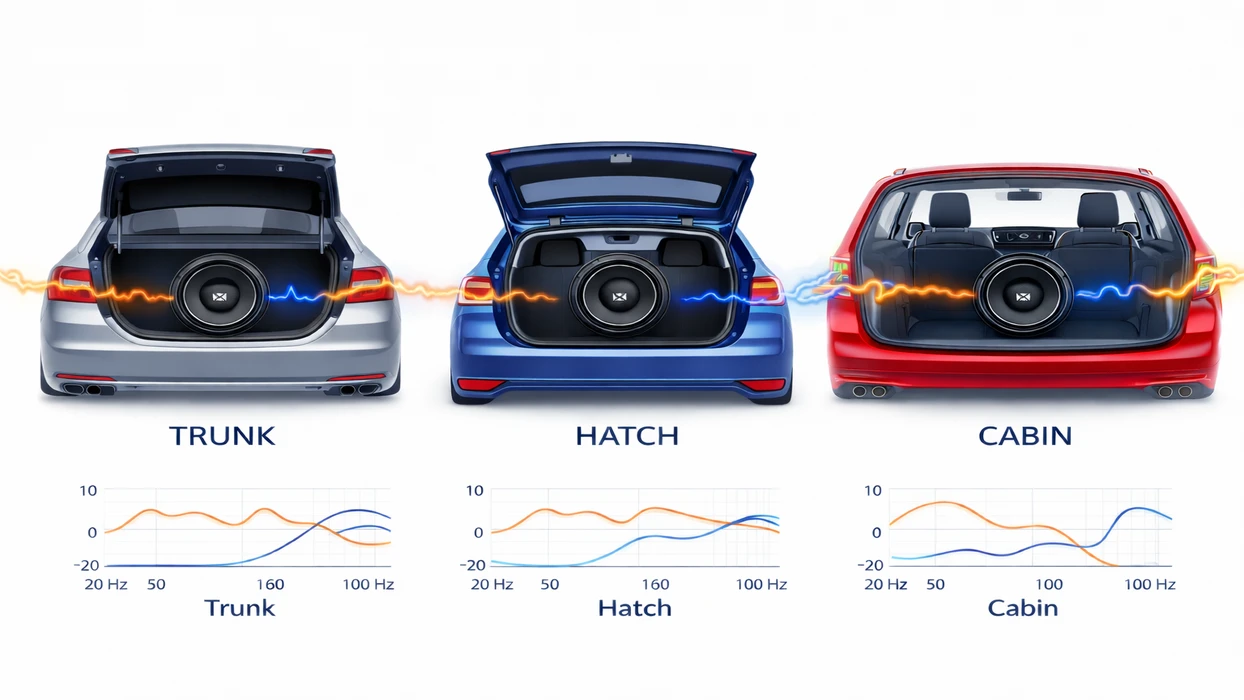
Bass frequencies behave differently from midrange and treble because of their wavelength. A 40 Hz note, for example, measures about 28 feet long, which is much longer than any car interior. Since low frequencies cannot fully develop inside a small cabin, they instead bounce, reflect, and pressurize the space.
This phenomenon is called cabin gain. At certain frequencies, the cabin naturally reinforces bass output, often giving the illusion of deeper extension. However, not all gain is good. Poorly managed reflections can cause standing waves that make some notes louder than others. The result is uneven bass that changes depending on where you sit.
Your goal as an installer or listener is to understand how your specific cabin behaves so you can position and tune your subwoofer accordingly.
Amplifier in the Trunk: Isolated but Controlled
Traditional sedans and coupes have enclosed trunks that are physically separated from the cabin. This creates a barrier between the subwoofer and the listener, affecting how low frequencies reach the front seats.
When a subwoofer is mounted in a sealed trunk, the bass energy must pass through the rear deck or seat openings to enter the cabin. This limits efficiency, particularly at higher bass frequencies (60–100 Hz). Drivers often notice that deep notes feel powerful, but midbass impact is muted.
Advantages of Trunk Installations
- Tighter, more controlled bass due to partial isolation
- Less cabin resonance and rattling when properly damped
- Cleaner soundstage for systems focused on front-stage imaging
Challenges of Trunk Installations
- Reduced bass transmission into the cabin
- Requires more amplifier power for equivalent output
- Possible phase cancellation between trunk and front speakers
Tuning Tip: Open the ski pass-through or fold-down seats when possible to allow the bass to couple more efficiently with the cabin. A small vent path can make a significant difference in perceived output.
Direct Coupling for Maximum Impact
Hatchbacks, crossovers, and SUVs place the subwoofer in the cargo hold, but since there’s no separation between the passengers, the subwoofer is functioning in the same air space as the listeners. This direct coupling allows bass energy to move freely throughout the cabin with minimal loss. The result is stronger, more immediate low-end response even with less amplifier power.
Advantages of Hatch and SUV Layouts
- Excellent bass efficiency due to shared cabin space
- More consistent frequency response across seating positions
- Greater output per watt compared to trunk installations
Challenges of Hatch and SUV Layouts
- More prone to resonance and rattling panels
- Requires sound deadening to control vibration and panel flex
- Rear reflections can cause peaks in certain bass frequencies
Tuning Tip: Position the subwoofer facing the rear of the vehicle. The added reflection from the hatch door reinforces low frequencies, increasing perceived output by up to 3 dB.
Open Cabins and Trucks: The Compromise Between Space and Output
Pickup trucks and open cabins present a unique acoustic challenge. The smaller cabin volume increases cabin gain, but the reduced space for enclosures limits subwoofer options. Under-seat and shallow-mount enclosures are common, providing bass presence without sacrificing seating or storage.
Advantages of Truck and Open-Cabin Systems
- Strong cabin gain enhances perceived depth even with smaller subs
- Enclosures can deliver impactful bass at lower power levels
- Excellent near-field response for front-seat listeners
Challenges of Truck and Open-Cabin Systems
- Limited enclosure volume restricts subwoofer selection
- Strong reflections from rear walls and glass can cause boomy response
- Difficult to achieve even bass coverage for rear passengers
Tuning Tip: Use a sealed enclosure for cleaner control in small cabins. Proper time alignment in the DSP or head unit can also improve blending with front speakers.
Optimizing Bass for Your Vehicle Type
| Vehicle Type | Acoustic Characteristics | Recommended Sub Placement | Key Considerations |
|---|---|---|---|
| Trunk (Sedan/Coupe) | Isolated cavity, limited cabin coupling | Face sub toward rear or seat opening | Needs venting or pass-through for best output |
| Hatchback/SUV | Shared airspace with cabin | Face sub toward hatch door | Add damping to reduce vibration and resonance |
| Truck/Open Cabin | Small volume, strong cabin gain | Under or behind seat | Use sealed or shallow enclosures for control |
How Cabin Shape and Materials Influence Sound
Beyond layout, remember that interior shape and materials also affect how bass behaves. Hard surfaces like glass and metal reflect energy, while soft materials like seats and carpet absorb it. This mix of reflection and absorption determines how the cabin responds to low frequencies.
Vehicles with irregular shapes – such as curved hatch doors or angled trunks – can help diffuse sound more evenly. Flat, parallel surfaces tend to trap certain frequencies, leading to audible “boom” or “hollow” spots. Adding damping materials behind panels helps control these resonances, making the bass sound tighter and more accurate.
Featured Sound Damping Products from NVX:



Overall
Every car interacts differently with bass frequencies. The same subwoofer that sounds powerful in a hatchback may feel restrained in a sedan simply because of acoustic isolation. When designing your system, focus on how your vehicle’s shape, materials, and volume affect low-frequency behavior. Tuning is just as important as hardware. Adjust phase, crossover, and placement to match your car’s natural acoustics. The goal is not just more bass but balanced bass – the kind that feels immersive and controlled no matter what you drive.
About The Authors

Benjie B.
Benjie has been writing automotive content for six years, and he loves the idea of democratizing knowledge through well-written and easy-to-understand content. He particularly enjoys the learning process behind writing and he’s fascinated by how vehicles and how the systems behind them work. Now, his work at Sonic Electronix has exposed him to the rabbit hole that is car audio systems, and he now wants to upgrade his family’s 20-year-old Toyota Yaris with a high-fidelity system someday. He enjoys watching content creators on YouTube, and he’s currently an avid cyclist, training so that his friends don’t leave him behind on group rides.

Hunter V.
Hunter is a Tech Support Lead at Sonic Electronix who also works with the company’s marketing and R&D team. With eight years of experience in the car audio installation space, Hunter likes to make sure that our customers are always happy with their purchase. In his past time, Hunter enjoys building subwoofers and spending time with his kids.