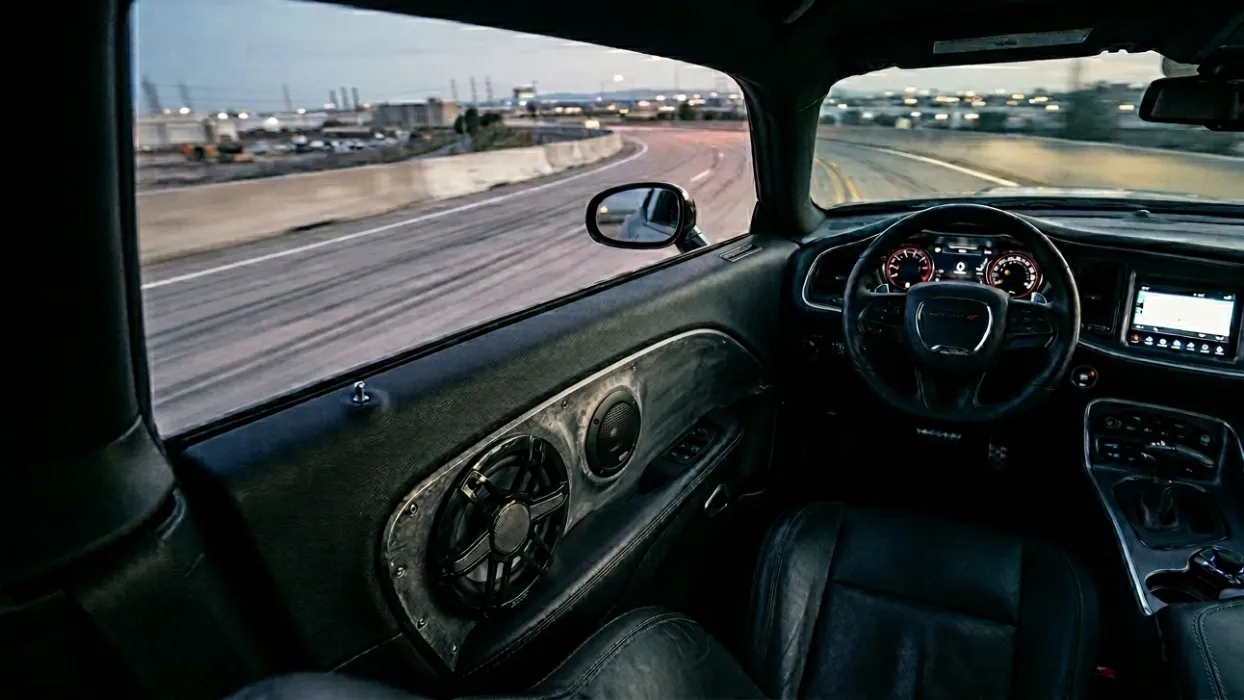
You hear less bass when windows are down because the vehicle interior transitions from a sealed acoustic environment to an open one. This shift eliminates cabin gain, vents low-frequency pressure, and introduces high levels of ambient noise. The low frequencies that felt authoritative with the windows up become physically harder for the system to generate and significantly more difficult for the human ear to perceive.
The Acoustic Physics of the Open Cabin
The Loss of Pressure Chamber Effect Low frequencies in a vehicle don’t travel through the air; they build static pressure because the cabin is a small, enclosed volume. With the windows up, the interior acts as a pressure chamber.
When you open a window, you create a high-velocity pressure leak. While the subwoofer continues to move the same amount of air (excursion), the cabin can no longer contain that pressure, resulting in a perceived drop in the lowest octaves.
Cabin gain (the natural reinforcement of low frequencies occurring within the confines of a small enclosure) is also significantly reduced. Lowering the windows effectively turns your car into an infinite baffle environment, stripping away this natural amplification. This is most noticeable in frequencies below 60 Hz, where the physical impact of the bass is most prominent.
Why Subwoofer Output Diminishes When Windows Are Open?
Frequency Masking and the Noise Floor When driving with windows down, wind and road noise levels increase exponentially. This noise is broadband, meaning it covers a wide range of frequencies, specifically overlapping with the mid-bass and upper-bass regions (60 Hz – 120 Hz). Even if the subwoofer’s electrical output remains constant, the bass-to-noise ratio collapses. The bass is still present, but it is being sonically buried by the outside environment.
Phase Shifting and Boundary Changes Opening a window fundamentally alters how sound waves reflect within the cabin. In a sealed environment, reflections are predictable. Once a boundary is removed, the pressure wave behavior changes, often creating new phase cancellations at the listening position. If certain bass notes disappear while others remain, you are experiencing a shift in the cabin’s standing waves and null points.
The One-Window-Down Effect (Helmholtz Resonance)
Cracking a single window often creates a rhythmic, pulsing sensation known as buffeting. This is a low-frequency pressure resonance caused by air rushing past the opening. This cycling pressure can make bass feel inconsistent or distorted. Opening a second window usually equalizes the pressure and stabilizes the acoustic environment.
How to Identify the Root Cause
If bass drops primarily at the lowest notes: This indicates a loss of cabin gain and pressure venting. The system is missing the reinforcement provided by a sealed cabin.
If bass drops primarily while the vehicle is in motion: This is frequency masking. The rise in the noise floor is drowning out the speakers.
If bass drops only on specific musical notes: This is a cancellation shift. The change in the cabin boundary has moved a null point directly onto your seating position for those specific frequencies.
How to Maintain Bass Response
Prioritize Sub-Level Control Over Gain Adjustments Do not attempt to fix windows-down bass loss by turning up the gain on your amplifier. This leads to clipping and thermal failure. Instead, use a remote bass knob or a head unit sub-level control. This allows you to temporarily compensate for the loss of cabin gain without permanently overdriving the equipment.
A high-quality remote controller, such as the NVX XVRC2, provides real-time voltage monitoring while allowing for these necessary adjustments.

Optimize Crossovers to Strengthen Mid-Bass A perceived loss of bass is often actually a loss of mid-bass clarity. Ensure your system is tuned as follows:
- Confirm the subwoofer low-pass filter (LPF) is not set unnecessarily low; 80 Hz is the standard starting point.
- Ensure door speakers have a dedicated high-pass filter (HPF) so they do not distort while trying to compete with the subwoofer.
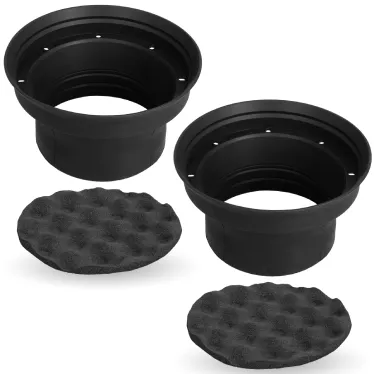
- Use a silicone baffle and sealing kit, like the NVX XBAF65, to couple the speaker to the door panel. This prevents the front and rear waves from canceling each other out, which is a leading cause of thin sound when windows are open.
Enclosure Selection and Cabin Coupling The physical design of your subwoofer system dictates how it handles environmental changes:
- Sealed Enclosures: These typically offer a shallower roll-off and more predictable behavior across different cabin pressures. They are the most consistent choice for varied driving conditions.
- Cabin Coupling: Subwoofers that fire directly into the cabin through a ski-hole or rear deck hold their presence better when windows are down. If your subwoofer is isolated in a trunk, you are fighting an uphill battle against the exterior noise floor.
Acoustic Treatment and Damping To improve the usable bass-to-noise ratio, you must lower the noise floor of the vehicle itself. Applying specialized damping material to the door skins, trunk, and floor prevents panels from resonating and acting as secondary (and out-of-phase) speakers. A comprehensive kit like the NVX SDTK20 provides enough coverage to solidify the vehicle’s surfaces, ensuring that the energy from your speakers reaches your ears rather than being wasted on vibrating sheet metal.

Bottom Line
Bass loss with windows down is a law of physics: you are losing pressure reinforcement while increasing ambient noise. The most effective strategy is to build a strong mid-bass foundation through proper door sealing and damping, while using a remote level control to intelligently manage subwoofer output based on your driving environment.
Would you like me to analyze your current crossover settings to see if your mid-bass can be further optimized for open-window driving?
About The Authors

Benjie B.
Benjie has been writing automotive content for six years, and he loves the idea of democratizing knowledge through well-written and easy-to-understand content. He particularly enjoys the learning process behind writing and he’s fascinated by how vehicles and how the systems behind them work. Now, his work at Sonic Electronix has exposed him to the rabbit hole that is car audio systems, and he now wants to upgrade his family’s 20-year-old Toyota Yaris with a high-fidelity system someday. He enjoys watching content creators on YouTube, and he’s currently an avid cyclist, training so that his friends don’t leave him behind on group rides.

John Haynes
John is an industry veteran, with 35+ years in the mobile electronics industry. Starting as a floor salesperson for Al & Ed's Autosound, he became a top-seller using sales techniques acquired in prior industries. He successfully managed locations, and was the first "non-technician" to be MECP and MECP 1st Class certified. His stores were one of the few in the chain that did truly high-end systems. He left A&E to manage the SoCal territory for Clifford Electronics, then returned to Al & Ed's as the buyer. He quickly became the General Manager for the company, and served in that position for almost 20 years. He tried to retire during COVID, got bored and became the US Sales Manager for an aftermarket auto accessory company until his retirement in 2025.
John enjoys spending time with his wife, two children and three grandchildren and his dog, Kenny. He enjoys playing guitar and banjo, woodworking, photography and volunteers in his local hospital as well as the local baseball/softball complex. Of course, he stays involved in 12-Volt, as it's something that never leaves you once it's in the blood.
"I'm pleased to be working with the Sonic Electronix marketing team," says John. "Sonic is a premier e-tailer, and I'm happy to be involved with them."