Speakers sound different at low volume versus high volume because your hearing changes with loudness and the speaker itself behaves differently as cone movement and power increase.
At low volume, the human ear is less sensitive to bass and treble, so music can seem thinner or less detailed even when the speaker is reproducing the signal accurately. At higher volume, those frequencies become easier to perceive, which changes the apparent tonal balance.
At the same time, higher output forces the speaker to move farther and handle more power. As excursion and heat rise, the driver becomes less linear, which can reduce clarity and introduce distortion.
The result is that changing volume affects perceived tuning and real-world speaker behavior, not just loudness.
Human Hearing Isn’t Linear
One of the biggest reasons speakers sound different at low volume comes from how our ears perceive sound.
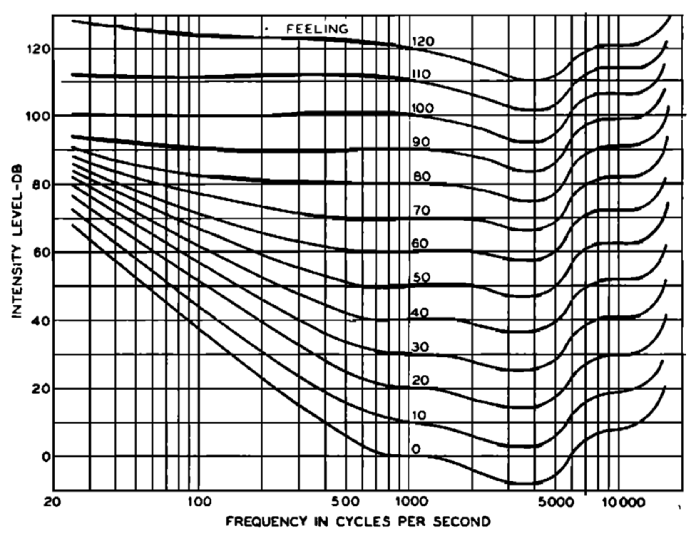
The Fletcher–Munson equal-loudness curves illustrate this principle. These curves show that the human ear does not respond equally to all frequencies at all loudness levels. We are more sensitive to the midrange and less sensitive to bass and treble, especially at lower volumes. At low volume levels, bass and treble frequencies must be significantly louder (higher sound pressure level) than midrange frequencies to be perceived as equally loud. This uneven sensitivity causes audio to sound “thin” or imbalanced at low volume.
As volume increases, our ears’ sensitivity to low and high frequencies shifts, making the frequency balance feel more even. This effect is the basis for features like loudness compensation on some audio systems, which boosts bass and treble at low listening levels to achieve a more natural perceived balance.
That said, even if our ears were perfectly linear, physical speaker behavior still changes with volume.
Speaker Mechanics Change With Drive Level
Speakers are mechanical devices. At low volume, the cone motion is small and the driver usually operates near its most linear region. This means distortion is minimal and frequency response stays closer to the speaker’s design target.
As volume rises, the cone excursion increases, meaning the speaker cone must move farther to reproduce louder sound. Greater excursion leads to more non-linear motion, which introduces distortion because the cone and suspension can no longer move uniformly in response to the electrical signal.
In addition, stray resonances – such as cone breakup (where parts of the cone vibrate independently) – can become audible at higher drive levels, further changing the character of the sound.
These mechanical limits are part of why speakers that sound clean and balanced at low volume can sound strained, compressed, or harsh as the playback level increases.
Perception Meets Physics
The interaction between how speakers behave physically and how our ears perceive sound amplifies the difference between low and high volume playback.
At low volumes:
- Human hearing downplays bass and treble relative to midrange because sensitivity is uneven.
- Small cone motion keeps distortion low.
At high volumes:
- The ear’s frequency response shifts, making low and high frequencies more audible relative to midrange.
- Speakers are pushed closer to their mechanical limits, increasing distortion and nonlinear behavior.
The result is a perceptual shift: sound may seem more balanced at high volume, even though physical limitations (distortion, breakup, compression) are increasing. This contrast is why some systems seem dull at low volume and more dynamic or heavier at high volume, even when the same signal is played.
What Changes in Real-World Listening
- Perceived balance shifts: At low volume, bass and treble often sound weaker compared to midrange due to human hearing sensitivity.
- Physical behavior changes: At higher output levels, increased cone excursion and nonlinear motion lead to distortion that alters the tonal character.
- Not all systems respond the same: Better-designed speakers maintain linear behavior over wider ranges, reducing perceptual differences between volumes.
Overall: Loudness Alters Perception and Performance
Speakers do sound different at low and high volumes for two intertwined reasons:
- Human hearing perception changes with amplitude – especially sensitivity to bass and treble.
- Speaker mechanics change with cone motion, leading to increased distortion and altered frequency balance at higher output.
Understanding both psychoacoustics and physical behavior makes it clear that volume isn’t just “louder” or “quieter.” It’s a complex interaction between how we hear and how speakers behave.
About The Authors

Benjie B.
Benjie has been writing automotive content for six years, and he loves the idea of democratizing knowledge through well-written and easy-to-understand content. He particularly enjoys the learning process behind writing and he’s fascinated by how vehicles and how the systems behind them work. Now, his work at Sonic Electronix has exposed him to the rabbit hole that is car audio systems, and he now wants to upgrade his family’s 20-year-old Toyota Yaris with a high-fidelity system someday. He enjoys watching content creators on YouTube, and he’s currently an avid cyclist, training so that his friends don’t leave him behind on group rides.

Dustin H.
Dustin is passionate about delivering honest car audio advice that serves both first-time buyers and seasoned car audio enthusiasts. A veteran of the car audio industry, he continues to learn about car audio space while building some systems of his own. Outside of his work in car audio, he’s active in his local church and enjoys spending time with family.