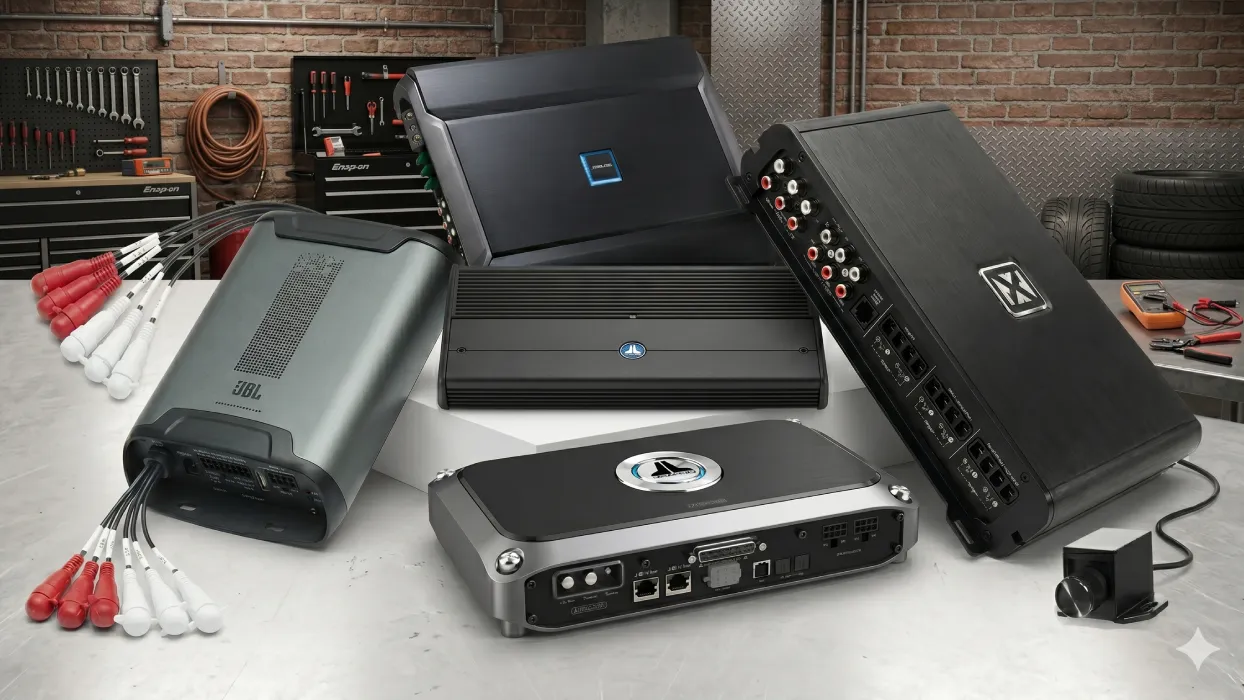
For a full-active system, these five amps cover the most practical 6-channel and 8-channel paths: NVX VAD22008 v2, JL Audio VX800/8i, JBL DSP4086, Alpine R-A90S, and JL Audio XDM600/6.
A full-active setup works when your channel plan and your signal processing match your speaker layout. Channel count is usually the limiter, not wattage.
What Is a Full Active Setup?
A full active build in car audio is a high-performance system configuration where each speaker driver (tweeter, midrange, woofer) is powered by its own dedicated amplifier channel. At the same time, the frequency crossovers are managed electronically before amplification, rather than through traditional passive crossovers.
This approach removes the need for passive crossovers between the amplifier and speakers, allowing for precise, individual control over each speaker’s timing, equalization, and crossover points.
At-a-Glance Comparison of the Five Picks
| Amplifier | Channels | Built-In DSP | Rated Power (4Ω) |
| NVX VAD22008 v2 | 8 | No | 150W x6 + 250W x2 |
| JL Audio VX800/8i | 8 | Yes | 75W x8 |
| JBL DSP4086 | 8 | Yes | 40W x8 |
| Alpine R-A90S | 6 | No | 75W x4 + 150W x2 |
| JL Audio XDM600/6 | 6 | No | 75W x6 |
Eight-Channel Picks for One-Chassis Active Builds
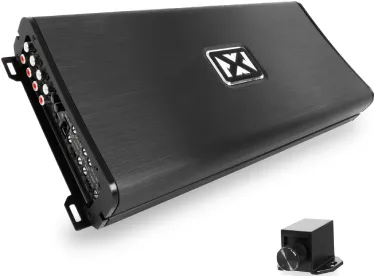
NVX VAD22008 v2
If your goal is strong per-channel output without forcing a two-amp front-stage layout, the VAD22008 v2 fits well because it gives real power on all channels, plus two higher-power channels that can be assigned to midbass duty.
It also supports 2-channel or 8-channel input modes, which helps when your signal source is limited and you’re relying on processing to create the final routing.
JL Audio VX800/8i
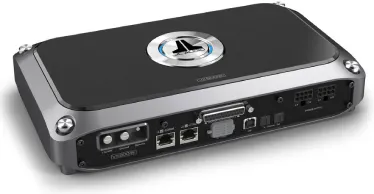
The VX800/8i makes sense when you want an 8-channel amp and DSP in one chassis so your crossover points, EQ, and delays live in the same ecosystem as the amplifier. It’s rated at 75W x 8 at 4 ohms and includes built-in DSP configuration via JL’s tuning software.
This is the approach if you want to reduce boxes and wiring complexity to keep active builds more manageable, especially in daily-driven vehicles with limited mounting space.
JBL DSP4086
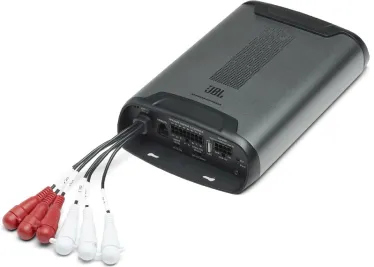
The DSP4086 is built around OEM-integration. This means it has a compact chassis, speaker-level input support, and onboard processing with eight powered outputs.
Its power rating (40W x 8 at 4 ohms) isn’t high-output, but that can still work well when:
- you’re using efficient speakers
- you’re prioritizing tuning control and staging
- you want a low-profile active solution that doesn’t demand a major electrical upgrade
Six-Channel Picks for Three-Way Front Stages
Alpine R-A90S
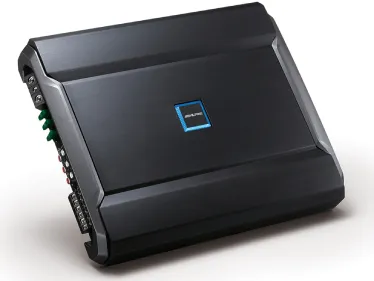
The R-A90S is a practical six-channel option when you want four channels for mids and highs plus extra headroom on the remaining pair. Its staggered layout is rated at 75W x4 + 150W x2 at 4 ohms.
That extra power can be assigned to midbass where cabin noise and door losses usually demand more output to stay balanced.
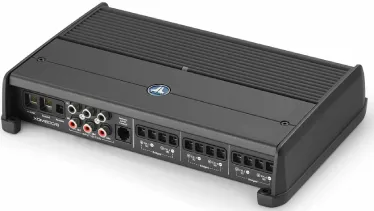
JL Audio XDM600/6
The XDM600/6 is a clean fit for a three-way active front stage when you want consistent full-range power across all six channels, rated at 75W x 6 at 4 ohms.
It also gives you the flexibility to bridge pairs if your design changes, but bridging is usually a plan B because it reduces channel count and can force compromises in driver control.
How Many Channels Do You Need for a Full Active System?
Active means each speaker driver gets its own amplifier channel so you can control it independently. That independence is the whole point because it lets you adjust each driver’s level, timing, and crossover behavior instead of living with a passive network’s fixed decisions.
Here are two channel maps that consistently stay clean as systems grow:
- 6-channel amp + mono sub amp (most common for three-way SQ)
- Ch 1–2: Tweeters (L/R)
- Ch 3–4: Midranges (L/R)
- Ch 5–6: Midbass (L/R)
- Sub: Separate mono amp
- 8-channel amp + mono sub amp (when you want rear fill or extra flexibility)
- Ch 1–6: Three-way front (L/R)
- Ch 7–8: Rear fill (L/R) or center/extra midbass experimentation
- Sub: Separate mono amp
What Forum Builders Prioritize in Real Full-Active Installs
A few themes show up repeatedly when people document what actually worked:
- Active is a tuning and wiring commitment. It takes more amplifier channels and more setup time than passive systems.
- Front stage first. Builders often recommend not spending channels on rears if it forces compromises up front.
- You don’t need to match the sub amp brand to the front-stage amp. The system outcome depends far more on DSP setup and install execution than on cosmetics.
- Keep the sub in the DSP signal path. DSP latency can create timing mismatch if the sub bypasses processing.
Closing Guidance for Picking the Right Amp
Pick your channel map first, then choose an amp that supports it without workarounds. A clean six-channel plus a dedicated sub amp is often the most stable three-way path, while an eight-channel platform gives you more flexibility when you want rear fill or you’re still refining the front-stage design.
About The Authors

Benjie B.
Benjie has been writing automotive content for six years, and he loves the idea of democratizing knowledge through well-written and easy-to-understand content. He particularly enjoys the learning process behind writing and he’s fascinated by how vehicles and how the systems behind them work. Now, his work at Sonic Electronix has exposed him to the rabbit hole that is car audio systems, and he now wants to upgrade his family’s 20-year-old Toyota Yaris with a high-fidelity system someday. He enjoys watching content creators on YouTube, and he’s currently an avid cyclist, training so that his friends don’t leave him behind on group rides.

John Haynes
John is an industry veteran, with 35+ years in the mobile electronics industry. Starting as a floor salesperson for Al & Ed's Autosound, he became a top-seller using sales techniques acquired in prior industries. He successfully managed locations, and was the first "non-technician" to be MECP and MECP 1st Class certified. His stores were one of the few in the chain that did truly high-end systems. He left A&E to manage the SoCal territory for Clifford Electronics, then returned to Al & Ed's as the buyer. He quickly became the General Manager for the company, and served in that position for almost 20 years. He tried to retire during COVID, got bored and became the US Sales Manager for an aftermarket auto accessory company until his retirement in 2025.
John enjoys spending time with his wife, two children and three grandchildren and his dog, Kenny. He enjoys playing guitar and banjo, woodworking, photography and volunteers in his local hospital as well as the local baseball/softball complex. Of course, he stays involved in 12-Volt, as it's something that never leaves you once it's in the blood.
"I'm pleased to be working with the Sonic Electronix marketing team," says John. "Sonic is a premier e-tailer, and I'm happy to be involved with them."