A factory equalizer that sounds different after adding an aftermarket amplifier is usually due to an external amplifier that changes how your factory radio signal is interpreted, amplified, and delivered to your speakers.
Modern factory head units are not neutral. They rely on heavy built-in equalization, time alignment, and dynamic processing tailored specifically to cheap, low-powered factory speakers.
When you introduce a high-performance amplifier, you alter the entire gain structure, voltage, and impedance interaction of the system. Let’s break down exactly why your factory EQ curves change after an amp upgrade and how you can restore perfect tonal balance.
Key Insights
- Factory head units are heavily pre-equalized and use dynamic processing like bass roll-off to protect cheap stock speakers, which distorts the audio balance when paired with a high-power external amplifier.
- An aftermarket amplifier introduces higher voltage, a vastly superior damping factor, and altered gain structures that expose hidden OEM tuning and make factory EQ choices sound harsh or muddy.
- Fixing the sound profile requires integrating active line output converters or a digital signal processor (DSP) to flatten the factory signal before it gets amplified.

1. Factory Head Units Are Pre-Tuned for Stock Speakers
Car manufacturers design factory audio systems to sound acceptable using the least expensive components possible.
To compensate for low-powered internal amplifiers, cheap paper cones, and poor cabin acoustics, automakers bake permanent EQ curves directly into the head unit.
Many original equipment manufacturer (OEM) systems include:
- Built-in equalization curves: Aggressive boosts in the lower mid-bass and treble to make small speakers sound larger.
- Dynamic loudness compensation: Boosting bass and treble at lower volumes to match human hearing thresholds, which often tapers off as you turn the dial up.
- Factory time alignment: Delaying signals to specific speakers to create a faux center image for the driver.
When you add an external amplifier, you significantly increase voltage and wattage.
A massive bass boost engineered to keep a weak 15-watt RMS factory speaker from sounding hollow can quickly become overbearing and distorted when fed 75 watts RMS from an aftermarket amp.
2. Amplifiers Reveal Hidden Factory Processing
Modern vehicles use internal Digital Signal Processing (DSP) to protect stock hardware. The most notorious variant is factory bass roll-off.
To prevent drivers from blowing out cheap factory speakers, the head unit automatically strips away low-end frequencies as the volume increases.
When you install an aftermarket amp using speaker-level inputs or standard line output converters, you are unintentionally amplifying a corrupted, heavily altered signal.
OEM tuning relies on non-linear processing that is tied strictly to factory hardware limitations. Once you boost that processed signal externally, the entire tonal balance shifts dramatically.
3. Gain Structure Changes Everything
Incorrect gain staging is a leading cause of poor sound quality after an amplifier upgrade. A common misconception is that the amplifier gain knob acts as a secondary volume control.
In reality, the gain control matches the input voltage from the radio to the output voltage of the amplifier.
- Gains set too high: The audio clips early, causing the treble to sound piercingly harsh, the bass to distort, and the background floor noise to hiss.
- Gains set too low: The system lacks dynamic punch, sounding thin and requiring you to crank the factory volume into its own distortion range.
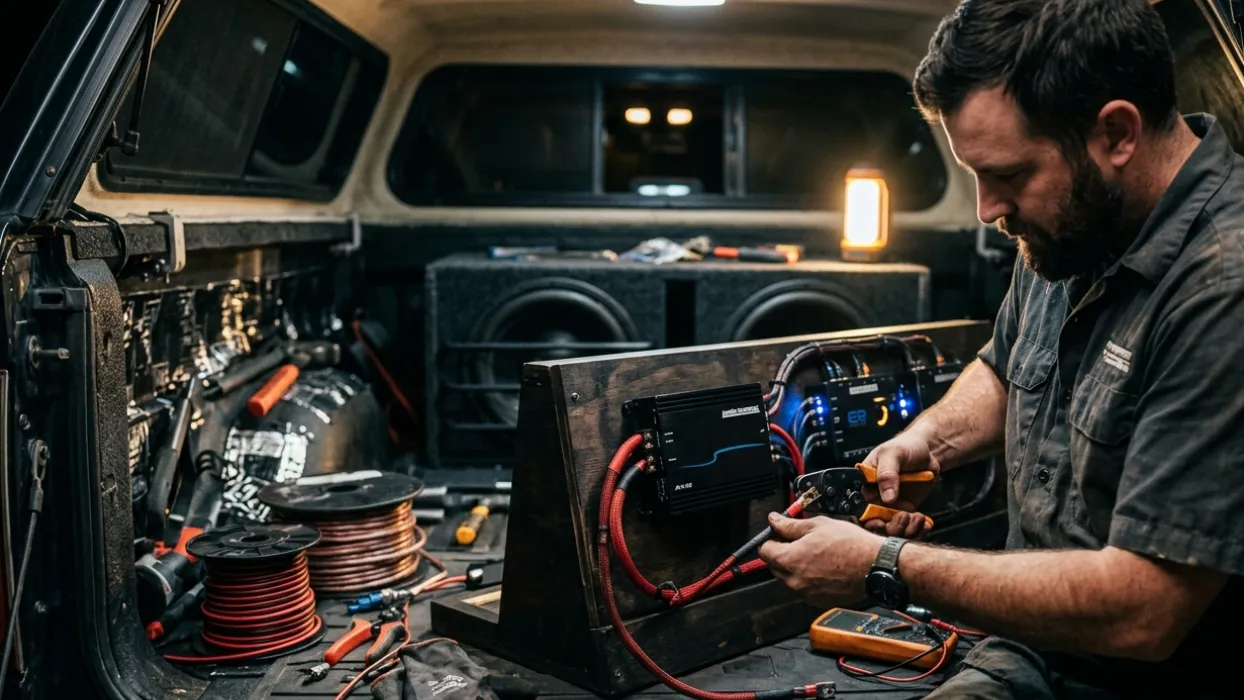
To keep your factory EQ sounding clean, gains should ideally be adjusted using a digital multimeter, an oscilloscope, or built-in distortion detection circuits.
4. Speaker Impedance and Damping Factor
Aftermarket amplifiers interact with your speakers far more efficiently than an OEM radio ever could.
External amplifiers feature a much higher damping factor, which refers to the amplifier’s ability to control the physical movement of the speaker cone after the audio signal stops.
A high damping factor provides tighter, faster, and more accurate bass response.
If your system suddenly feels like it has less bass punch after adding an amp, you are likely just hearing accurate, controlled mid-bass rather than the muddy, loose resonance generated by the factory radio.
Furthermore, if you swapped your stock 4-ohm speakers for high-efficiency 2-ohm speakers during the install, the change in impedance alters power distribution and inherently reshapes your system frequency response.
5. Standard Line Output Converters vs. Active Integration
If you connected your factory radio to your new amplifier using a cheap, passive line output converter, your signal quality will suffer.
Low-end passive integration tools can restrict dynamic range, introduce ground loops, and completely fail to fix factory bass roll-off.
To overcome factory EQ manipulation, you need modern, active integration gear.
High-quality integration units offer load simulation to trick smart factory radios into staying active, signal summing to combine separate tweeter and woofer outputs, and automated bass restoration to reverse OEM roll-off.
About The Authors

Christine F.
Christine is a dedicated content writer with over five years of experience covering a variety of automotive and car audio topics, transforming technical knowledge into compelling and easy-to-understand content. She’s passionate about writing articles that educate, empower, and inspire drivers and audio enthusiasts everywhere. In her free time, she enjoys playing tennis and going on walks with her dog.

John Haynes
John is an industry veteran, with 35+ years in the mobile electronics industry. Starting as a floor salesperson for Al & Ed's Autosound, he became a top-seller using sales techniques acquired in prior industries. He successfully managed locations, and was the first "non-technician" to be MECP and MECP 1st Class certified. His stores were one of the few in the chain that did truly high-end systems. He left A&E to manage the SoCal territory for Clifford Electronics, then returned to Al & Ed's as the buyer. He quickly became the General Manager for the company, and served in that position for almost 20 years. He tried to retire during COVID, got bored and became the US Sales Manager for an aftermarket auto accessory company until his retirement in 2025.
John enjoys spending time with his wife, two children and three grandchildren and his dog, Kenny. He enjoys playing guitar and banjo, woodworking, photography and volunteers in his local hospital as well as the local baseball/softball complex. Of course, he stays involved in 12-Volt, as it's something that never leaves you once it's in the blood.
"I'm pleased to be working with the Sonic Electronix marketing team," says John. "Sonic is a premier e-tailer, and I'm happy to be involved with them."