Listening to your favorite tunes, then having them cut out because of your subwoofer, is the worst. It’s quite easy to assume that the sub is just failing, but that’s rarely the case.
In reality, your car amplifier is likely stepping in to save the day by entering protection mode.
Modern amplifiers are equipped with smart protection circuits designed to shut down the output before permanent damage to components occurs.
If your system runs fine for a short period before cutting out, something is gradually triggering a safety limit. Here’s a breakdown of what’s actually happening behind the dashboard and how you can diagnose the problem like a professional installer.
Key Insights
- Subwoofer cutouts that occur after 10 to 15 minutes are almost always caused by the amplifier entering protection mode to prevent damage from thermal buildup, electrical shorts, or severe voltage drops, rather than a failing subwoofer.
- The most frequent triggers for this delayed shutdown include insufficient airflow around the amplifier, wiring subwoofers below the amplifier’s minimum rated impedance limit, or a loose remote turn-on wire.
- You can permanently resolve the issue by optimizing amplifier ventilation, ensuring ground connections are secured to bare chassis metal, and upgrading to high-quality, true-gauge installation kits.
What Happens When the Bass Stops?
When an amplifier detects an electrical or thermal anomaly, it shuts off power to the speaker outputs. This is usually indicated by a red or flashing protection light on the amplifier chassis.
Amplifiers monitor three major safety parameters:
- Thermal overload: Extreme internal heat buildup
- Short circuits: Direct contact between live wires or a damaged voice coil
- Voltage fluctuations: Dangerous drops or spikes in the vehicle’s electrical system
By pinpointing exactly why the amplifier is going into protection mode, you can eliminate the shutdown and get back to consistent, deep bass.
The 5 Most Common Causes and How to Fix Them
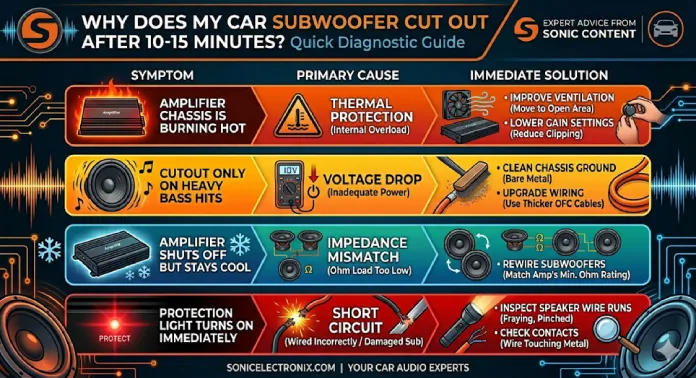
1. The Amplifier Is Overheating (Thermal Protection)
If the cutout happens like clockwork after 10 to 15 minutes of play, thermal overload is the prime suspect.
Heat accumulates slowly as the internal components work. Once the internal temperature crosses a safe threshold, the amplifier goes into thermal lockdown.
Common culprits for overheating include:
- Poor airflow: Mounting the amplifier under heavy carpeting, inside tight storage compartments, or upside down traps heat. Top manufacturers explicitly warn against mounting amplifiers where there is insufficient air circulation for proper cooling.
- Aggressive settings: Setting the gain or bass boost too high forces the amplifier to clip, producing massive amounts of heat.
Expert Check: Carefully feel the amplifier chassis immediately after it cuts out. If it’s hot to the touch, you have a cooling issue. Reposition the unit to maximize airflow, avoid covering it, and consider spacing or ventilation upgrades.
2. Wiring Impedance Is Too Low
Connecting your subwoofers in a configuration that drops the impedance (ohms) below the amplifier’s rated limits causes excessive current draw. This forces the amplifier to run scorching hot and trip its safety circuits.
Low impedance is the primary reason why systems shut down. A frequent mistake is wiring two 4-ohm subwoofers in parallel, which drops the load to 2 ohms, and then bridging them to an amplifier that is only stable down to 4 ohms when bridged.
3. Severe Voltage Drop
Deep bass tracks demand a massive amount of instantaneous current. If your vehicle’s electrical system can’t keep up, the voltage at the amplifier power terminals will plummet.
When the voltage drops below a certain threshold, the low-voltage protection circuit triggers an immediate shutdown. Poor power and ground connections are common causes of severe voltage drop and subsequent thermal failure.
To check this yourself:
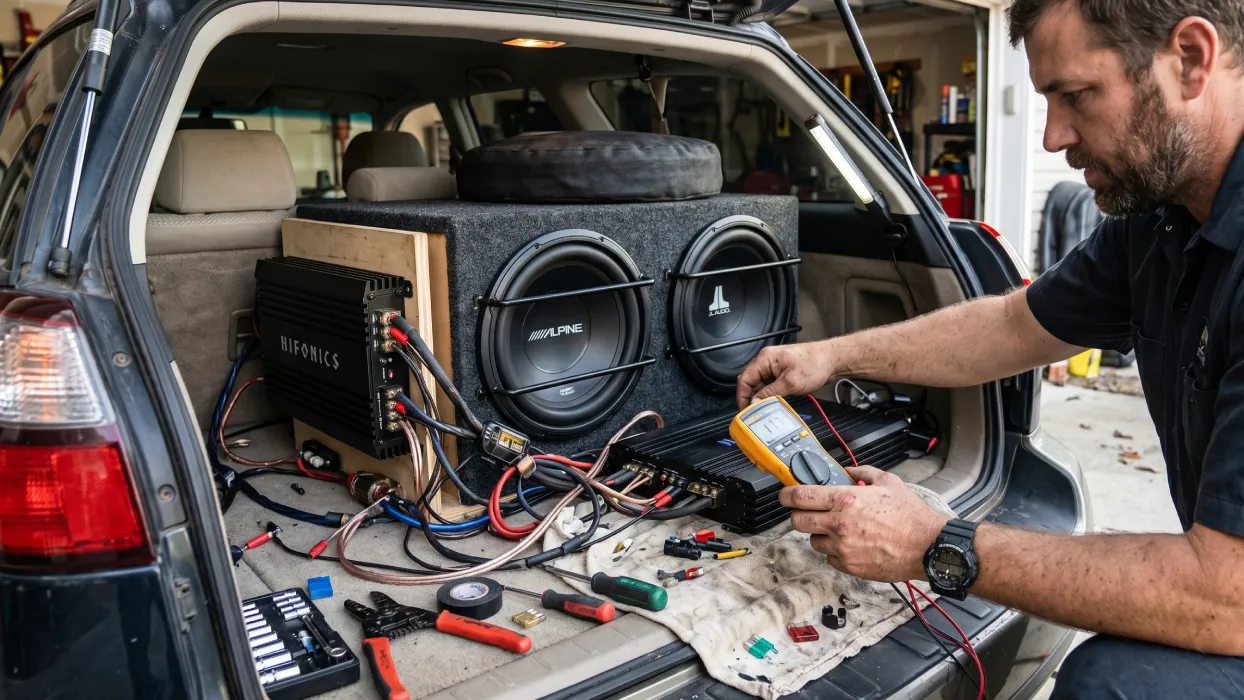
- Connect a digital multimeter to the positive +12V and ground terminals directly on the amplifier
- Monitor the reading while playing a heavy bass line at regular volume
- If the voltage drops dramatically when the bass hits, your electrical system is struggling
Installation Tip: Ensure your ground wire is attached directly to bare, unpainted metal to prevent resistance.
4. A Faulty Remote Turn-On Signal
The remote turn-on wire tells your amplifier when to wake up and when to sleep based on a switched +12V signal from your head unit. If this signal drops out, the amplifier turns off instantly.
This can cause a 10 to 15-minute cutout due to loose connections that expand or separate as the vehicle vibrates or warms up.
Additionally, some factory stereo integration modules that use signal-sensing technology can fail or turn off unexpectedly during quiet musical passages.
Using a multimeter to measure the remote-to-ground voltage when the sub cuts out will tell you if the head unit or integration harness is to blame.
5. Speaker Wiring Shorts and Blown Subwoofers
A pinched speaker wire, a stray strand of copper touching the vehicle’s metal chassis, or an internally shorted voice coil will look like a short circuit to the amp. Grounded or blown speakers can lead to immediate amplifier protection shutdowns.
To resolve this issue, disconnect the speaker wires from the amplifier outputs immediately after a cutout.
If the amplifier turns back on and stays out of protection mode, the problem lies within your speaker wiring or the subwoofer itself. Never connect speaker cables to the vehicle chassis ground.
About The Authors

Christine F.
Christine is a dedicated content writer with over five years of experience covering a variety of automotive and car audio topics, transforming technical knowledge into compelling and easy-to-understand content. She’s passionate about writing articles that educate, empower, and inspire drivers and audio enthusiasts everywhere. In her free time, she enjoys playing tennis and going on walks with her dog.

John Haynes
John is an industry veteran, with 35+ years in the mobile electronics industry. Starting as a floor salesperson for Al & Ed's Autosound, he became a top-seller using sales techniques acquired in prior industries. He successfully managed locations, and was the first "non-technician" to be MECP and MECP 1st Class certified. His stores were one of the few in the chain that did truly high-end systems. He left A&E to manage the SoCal territory for Clifford Electronics, then returned to Al & Ed's as the buyer. He quickly became the General Manager for the company, and served in that position for almost 20 years. He tried to retire during COVID, got bored and became the US Sales Manager for an aftermarket auto accessory company until his retirement in 2025.
John enjoys spending time with his wife, two children and three grandchildren and his dog, Kenny. He enjoys playing guitar and banjo, woodworking, photography and volunteers in his local hospital as well as the local baseball/softball complex. Of course, he stays involved in 12-Volt, as it's something that never leaves you once it's in the blood.
"I'm pleased to be working with the Sonic Electronix marketing team," says John. "Sonic is a premier e-tailer, and I'm happy to be involved with them."