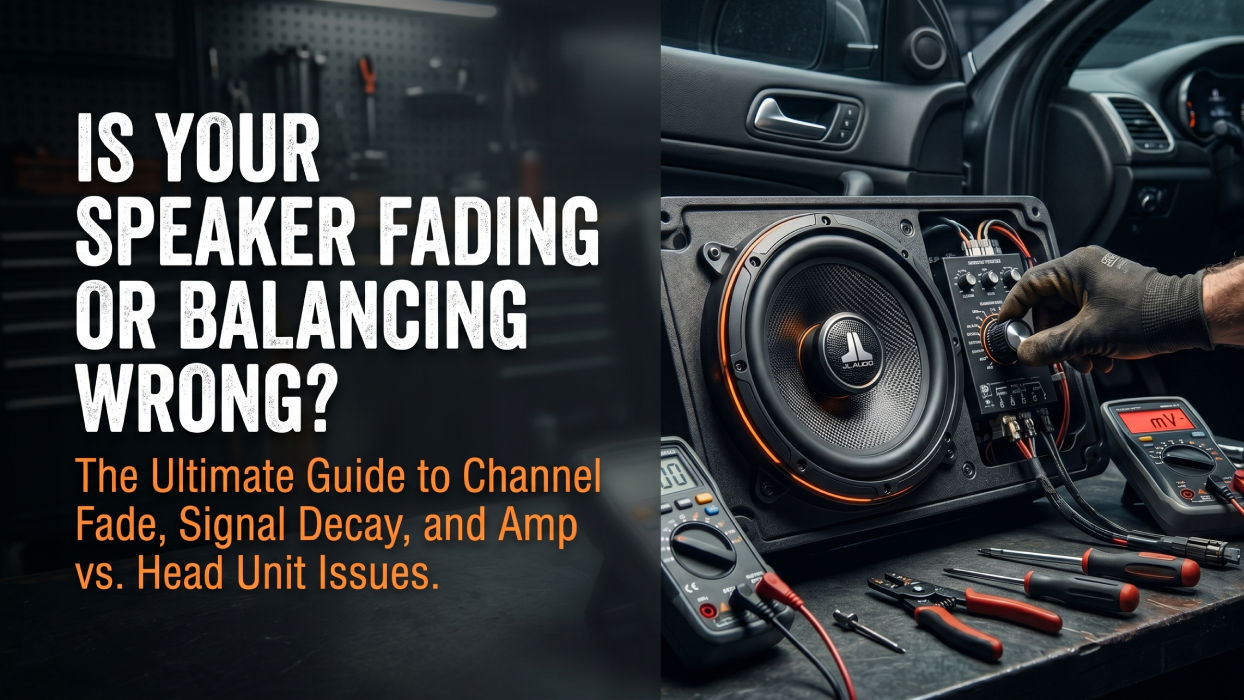
Your speakers fade left or right over time because one channel is losing signal or output as conditions change. This is usually the result of a weak connection, door wiring fatigue, amplifier channel stress, or a speaker component that’s failing.
Sometimes, this can just be a perception issue caused by hearing imbalance (ear-related issue), which can feel like the system is shifting even when the hardware is stable.
What Left-Right Fade Usually Sounds Like
Most people describe this as the center image slowly pulling toward one door. Vocals that were once centered start sounding like they are coming primarily from the driver side or passenger side. This symptom is useful because it points to a problem affecting one channel more than the other, rather than a failure of the entire system.
Is It the Music, the Source, or the System?
Before assuming hardware failure, isolate the easiest variables by asking these key questions:
Does it happen on every source? If it only happens on Bluetooth, CarPlay, or one specific streaming app, the issue can be source-specific. Some phones and apps apply independent left-right processing, accessibility audio balance, or connection behavior that changes after reconnecting. If it happens on every source, the fault likely lies in the signal chain.
Does it happen with headphones too? If your headphones drift left or right in the same way, your hearing might be changing throughout the day or during the session. If headphones stay centered but the car audio does not, the problem is in the vehicle.
Does it go away if you turn the volume down? If lowering the volume temporarily fixes the imbalance, that often points to heat-related behavior in a speaker, crossover, or amplifier channel.
The Most Common Causes in Real Vehicles
Why would it fade during a drive or a long listening session? These causes fluctuate with vibration, temperature, or electrical current demand.
- Loose RCA or input connection: A slightly loose RCA plug can make one channel intermittently drop its signal level, especially when the vehicle vibrates or the amplifier warms up. This can sound like a slow drift because the connection is not fully failing; it is just becoming resistive.
- Door wiring fatigue at the hinge boot: Factory and aftermarket door wiring flexes every time the door opens. Over time, copper strands can break inside the insulation. This raises resistance or causes intermittent contact, often worsening when the door moves or the cabin warms up.
- Speaker voice coil heating and power compression: As a speaker heats up, its electrical resistance rises. This reduces output. If one side is already weaker due to mounting, impedance, or damage, the hotter side can fall back first and shift the audio image.
- Amplifier channel stress or protection behavior: If one channel is driving a lower impedance, has a partial short, or is wired incorrectly, it can heat faster and reduce output sooner. Some amplifiers do not shut down immediately; they behave inconsistently first.
Why would it get worse over weeks or months? These represent slow-failure patterns.
- Tweeter or coaxial high-frequency failure: If a tweeter on one side is partially damaged, the system can still play, but that side loses clarity and presence. Your brain interprets that loss of detail as the sound moving to the other side.
- Passive crossover damage or resistor drift: In component sets, a failing capacitor or resistor can change the volume level on one side. This kind of failure often shows up as a slow change rather than a sudden death.
- Moisture and corrosion at terminals: Door environments are harsh. Moisture can oxidize terminals, spade connectors, or adapter harnesses. Oxidation increases resistance and lowers output over time.
The Fastest Way to Pinpoint the Problem
This sequence tells you whether the fade is coming from the head unit, the amplifier, or the speaker wiring.
Step 1: Reset balance and processing Set EQ to flat, disable loudness, disable time alignment effects, and center the balance and fader. If the drift disappears, a processing setting or source behavior was the cause.
Step 2: Swap left and right inputs at the amplifier Swap the RCA inputs at the amp (left to right, right to left).
- If the fade switches sides, the problem is upstream (head unit, DSP, RCAs, or source).
- If it stays on the same side, the problem is downstream (amp channel, wiring, or speaker).
Step 3: Swap left and right speaker outputs at the amplifier Swap the speaker wires at the amp output.
- If the fade switches sides now, the amplifier channel is suspect.
- If it still stays on the same physical door, the wiring run or the speaker is suspect.
Step 4: Move the door and listen Open and close the door slightly while playing a steady vocal track. If the sound changes with door movement, the hinge boot wiring or a loose connection in the door is the likely culprit.
When It Is Not the System
If the drift happens in multiple cars, in headphones, and on home speakers, and it does not track with swapping channels, then it is worth considering hearing asymmetry. Earwax buildup, congestion, and hearing fatigue can shift perceived balance, especially at higher volumes. If it is persistent and noticeable across all devices, a hearing check is a better diagnostic than buying new gear.
Fixes That Usually Solve Left-Right Fade
- Re-terminate and secure connections: Tighten RCAs, re-crimp loose spade connectors, and avoid leaving bare wire under a screw where vibration can loosen contact.
- Repair door wiring correctly: If the hinge boot has broken strands, patching one spot often is not enough. Use a flexible repair section with strain relief so the same point does not break again.
- Set high-pass filtering on door speakers: Many door speakers are stressed because they are asked to play too low. A proper high-pass filter reduces excursion and heat, improving consistency between left and right.
- Confirm amplifier gain and load matching: If one channel is clipped or loaded differently, it will behave differently over time. Matching impedance and setting gains conservatively prevents heat-driven drift.
Bottom Line: A left-right fade is almost always a channel-specific weakness that changes with heat, vibration, or resistance, not a mysterious tuning issue. The fastest path is to swap left and right at the amp inputs and outputs to see whether the problem follows the signal or stays with the physical door.
About The Authors

Benjie B.
Benjie has been writing automotive content for six years, and he loves the idea of democratizing knowledge through well-written and easy-to-understand content. He particularly enjoys the learning process behind writing and he’s fascinated by how vehicles and how the systems behind them work. Now, his work at Sonic Electronix has exposed him to the rabbit hole that is car audio systems, and he now wants to upgrade his family’s 20-year-old Toyota Yaris with a high-fidelity system someday. He enjoys watching content creators on YouTube, and he’s currently an avid cyclist, training so that his friends don’t leave him behind on group rides.

John Haynes
John is an industry veteran, with 35+ years in the mobile electronics industry. Starting as a floor salesperson for Al & Ed's Autosound, he became a top-seller using sales techniques acquired in prior industries. He successfully managed locations, and was the first "non-technician" to be MECP and MECP 1st Class certified. His stores were one of the few in the chain that did truly high-end systems. He left A&E to manage the SoCal territory for Clifford Electronics, then returned to Al & Ed's as the buyer. He quickly became the General Manager for the company, and served in that position for almost 20 years. He tried to retire during COVID, got bored and became the US Sales Manager for an aftermarket auto accessory company until his retirement in 2025.
John enjoys spending time with his wife, two children and three grandchildren and his dog, Kenny. He enjoys playing guitar and banjo, woodworking, photography and volunteers in his local hospital as well as the local baseball/softball complex. Of course, he stays involved in 12-Volt, as it's something that never leaves you once it's in the blood.
"I'm pleased to be working with the Sonic Electronix marketing team," says John. "Sonic is a premier e-tailer, and I'm happy to be involved with them."