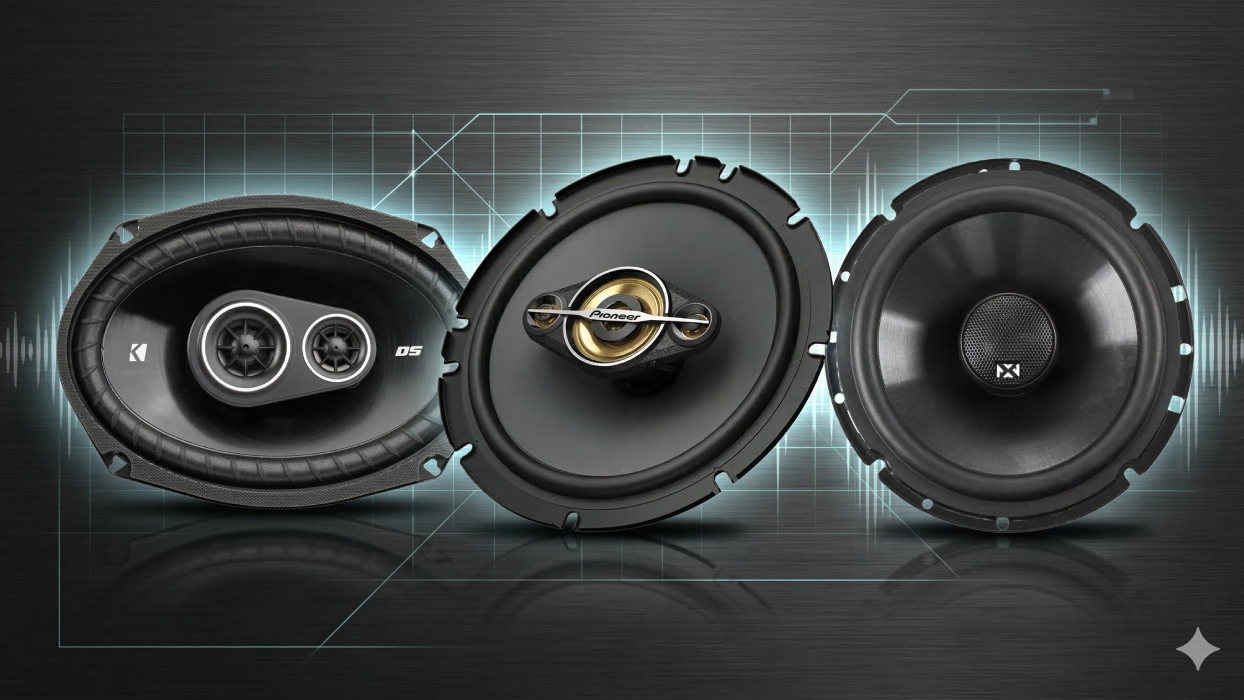
Before we get started, it’s important to understand that all of these speakers below are coaxial speakers. If you are unsure about the difference between coaxial and component speakers, make sure to refer to our article that establishes the main differences between the two. When purchasing speakers, it’s good to be aware of the options that are available to you.
There are three distinct types of coaxial speakers, 2-way, 3-way and 4-way speakers. This article is going to dive into the key differences between each so that when you go to buy, you will know which will be best for you. The differences between the three types are fairly simple. The number simply explains the amount of drivers each speaker contains.
2-Way Speakers
2-way seakers have two separate, distinct frequency bands. One of which is the woofer which produces the lows. The other is the tweeter which produces higher frequency sounds. This allows you to get some bass and clearer sounds at higher pitches as well.
3-Way Speakers
3-way speakers simply contain three separate drivers that produce audio at three separate frequencies. They produce sounds in the highs, mid-range and low frequencies. They contain a woofer and a tweeter just like 2-way speakers do, but they also contain a mid-range driver. Just as it sounds, mid range drivers produce the mid-range frequencies.
4-Way Speakers
A 4-way speaker is very similar to a 3-way speaker except it actually provides an additional tweeter to help produce more of that high-end sound. This gives you a great range of sound at all frequencies.
Quick Comparison Table
| Feature | 2-Way | 3-Way | 4-Way |
|---|---|---|---|
| Typical Layout | Woofer + Tweeter | Woofer + Tweeter + Supertweeter | Woofer + Tweeter + 2x Supertweeters |
| Sound Character | Balanced & Smooth | Detailed & Present | Very Bright & Energetic |
| Complexity | Low (Minimal phase issues) | Moderate | High (Potential for treble peaks) |
| Best For | Accuracy & Coherence | Added “Sparkle” | Maximum High-Frequency Output |
Real-World Examples
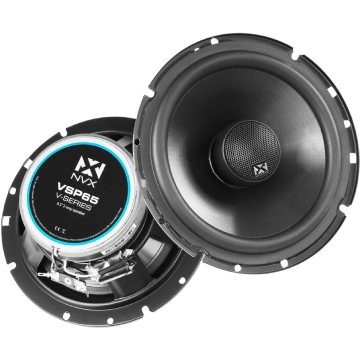
NVX VSP65 (2-Way Coaxial, 6.5-inch)
This is a classic 2-way design. It uses a single silk-dome tweeter and a sturdy woofer cone. Because it doesn’t try to cram extra drivers into the center, the crossover is simple, resulting in a smooth, “audiophile-lite” sound that works well for almost any genre.
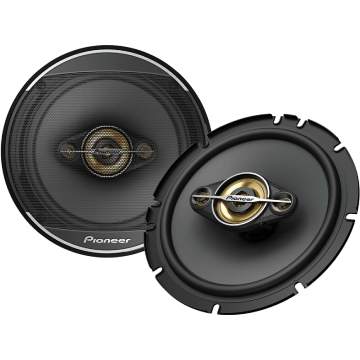
Pioneer TS-A1681F (4-Way Coaxial, 6.5-inch)
A hallmark of Pioneer’s A-Series, this 4-way speaker is designed for impact. With a woofer and a triple-threat of high-frequency drivers, it is significantly “brighter” than the NVX. It is ideal for listeners who want their music to “cut through” road noise in older or louder vehicles.
Which is Best?
A speaker with more drivers does not mean it is inherently a better speaker. A 2-way speaker could very well produce a much higher quality sound than that of a 4-way speaker. A 2-way speaker with two high quality drivers will sound much better than a 4-way speaker with 4 cheap drivers. It may have a larger range of frequencies, but none of those ranges would sound any good. With that being said, if you are looking at two high quality speakers and one is a 2-way and the other is a 4-way, the 4-way would give you that larger range of sound that would give you more detail in the mids and the highs. There are options with even more drivers, but as previously stated, more drivers does not necessarily mean better sound quality.
Bottom Line
- Choose 2-Way for the most accurate, natural reproduction of your music.
- Choose 3-Way for a noticeable boost in clarity over dull factory speakers.
- Choose 4-Way if you love high-energy treble and want the most “detailed” sound possible.
Would you like me to help you compare the specific mounting depths or power requirements for these types of speakers?
Refer to our blog to get a better understanding of car audio equipment in general. We also have various articles that will help you purchase and install products that will best fit your needs and your budget.
About The Authors